It was June 2024, and we were back visiting the beautiful Isle of Arran. My last story was about Garden Cottage in Sannox where we stayed for a full week with more time to enjoy the island. Staying more than a few days doesn’t happen very often, so I was really excited to be here longer.
For our anniversary day I booked a sailing with Lamlash Cruises to revisit Holy Isle, a small island in the Firth of Clyde dedicated to world peace and health. In 2023 we hiked to Mullach Mòr, the highest point on Holy Isle, but missed walking along the coastal path on the island, so I vowed we would return the following year.
Read about our hike up to Mullach Mòr on Holy Isle
The low-level coastal walk shouldn’t be as strenuous as the hike I thought, so I was feeling more relaxed about this visit and not worrying too much about not having time to see everything. Gently breaking our legs in for our planned Glen Sannox hike later in the week was perfect as well.
Setting out early, we drove south to Lamlash arriving in time for the 10:30am sailing. It was a rather cloudy day, but pockets of blue sky were looking promising. We might be lucky to see the sunshine at some point, but no matter what the weather I was still going to enjoy our day.
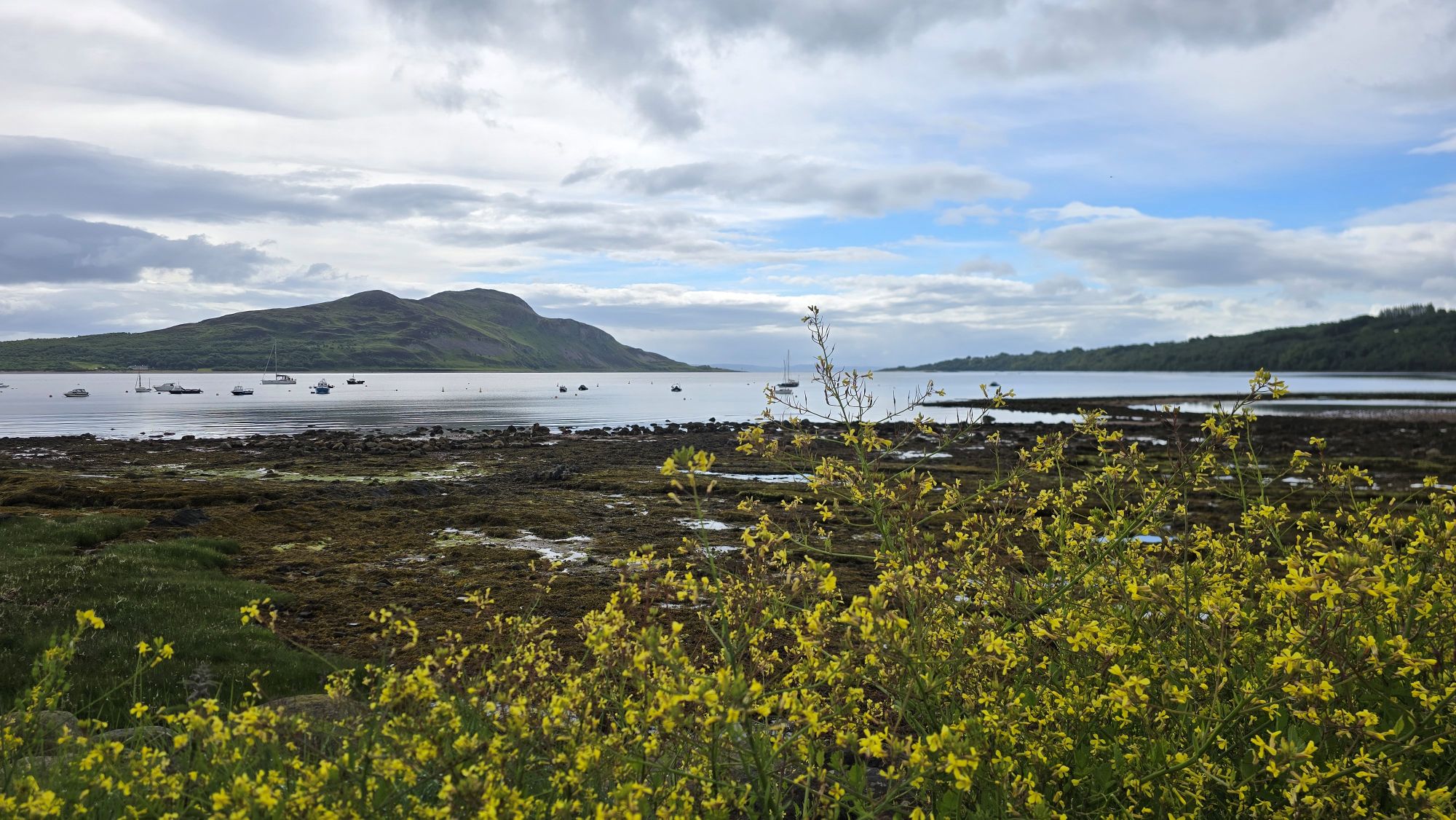
We parked our car in the Shore Road Car Park and wandered down to the Old Pier. While we were waiting, I had a go at sailing … well, I pretended to be sailing and was acting like a child as I took control of the Helm and turned the old steering wheel at the pier. I just couldn’t help myself. 😂
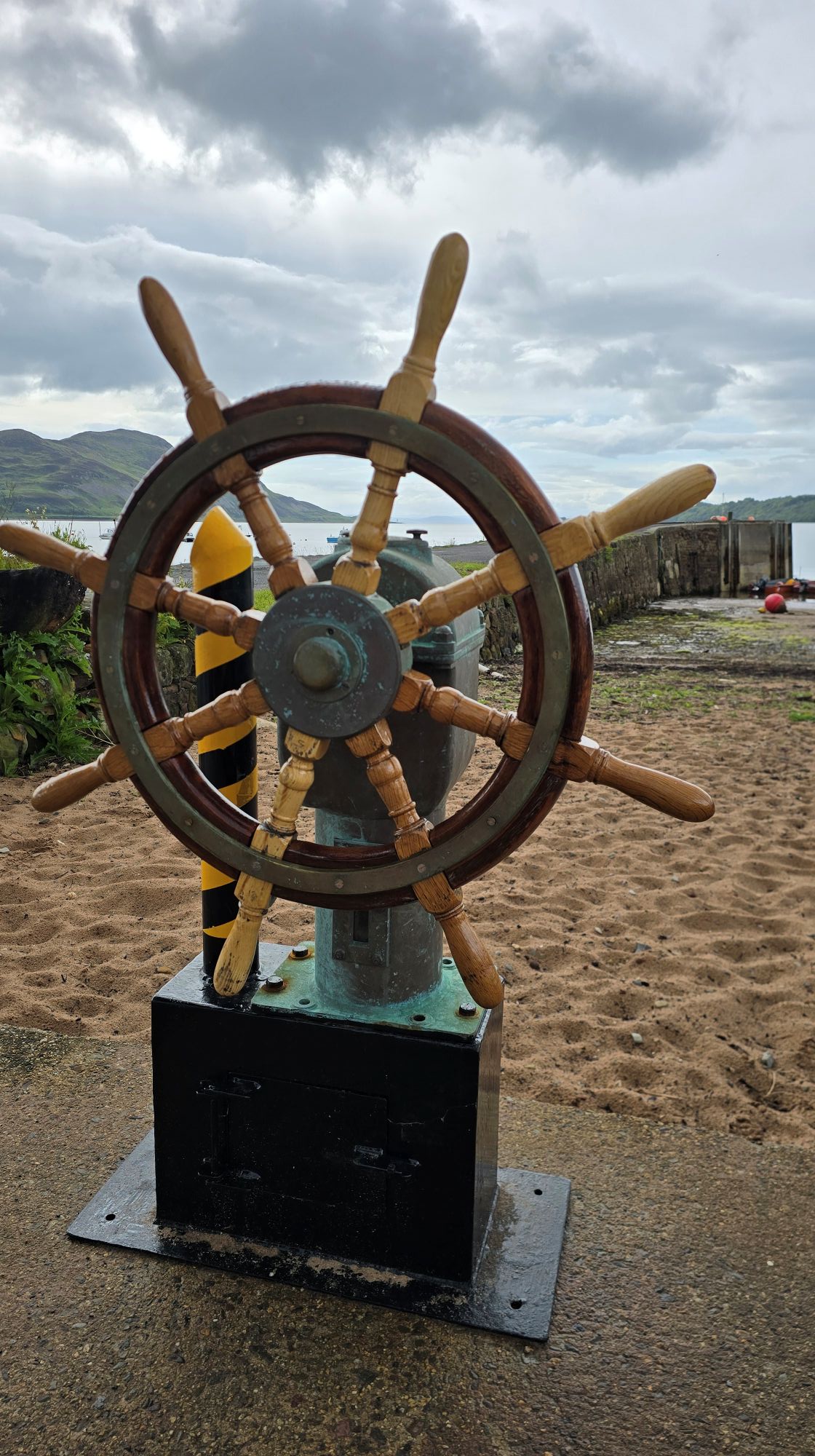
Lamlash Cruises not only offer sailings to Holy Isle, but also unique RIB (Rigid Inflatable Boat) tours from Brodick, excursions to Corrie and more. I’ll link their website at the end if you would like to know more.
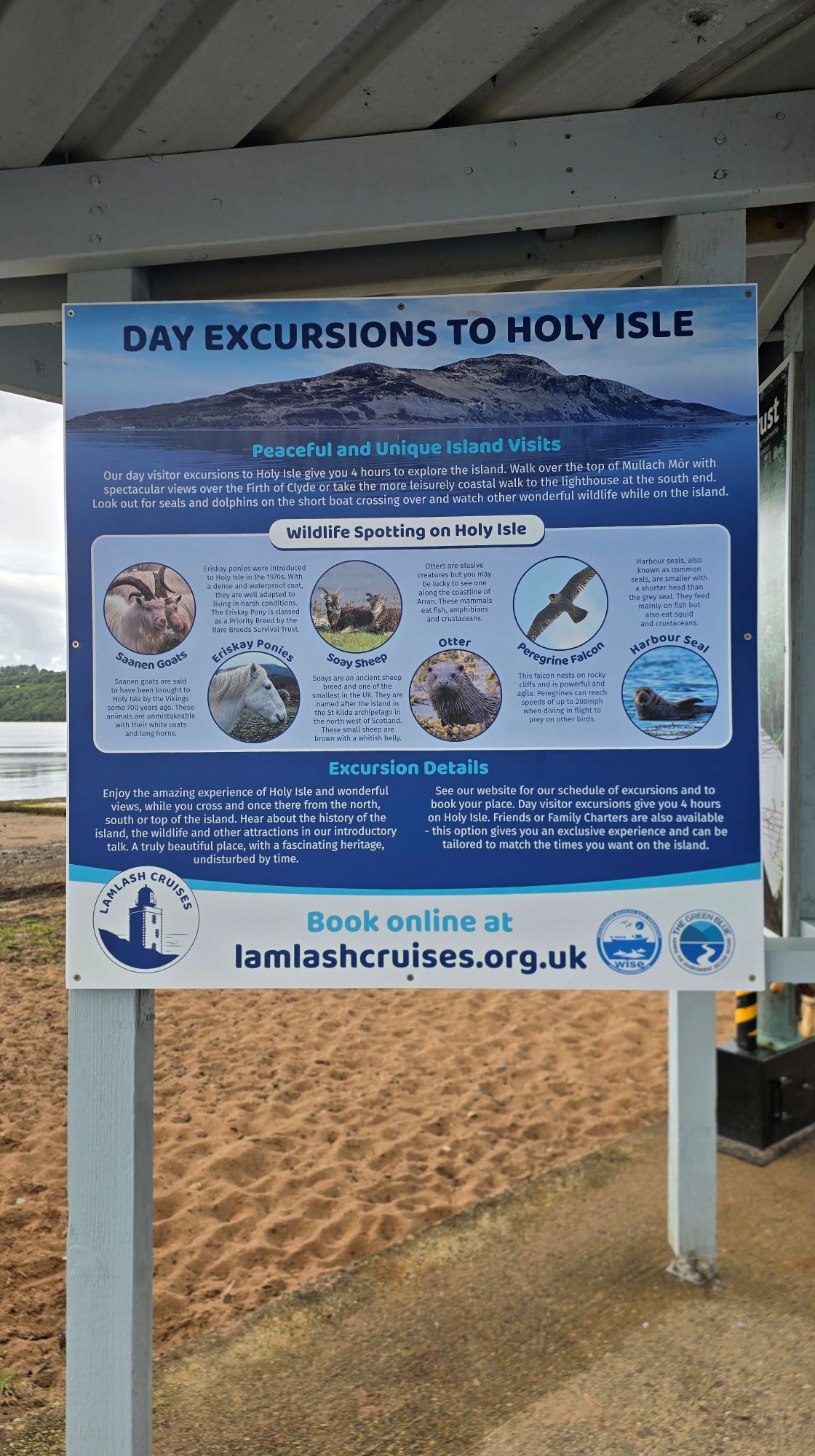

We joined a small group who were also visiting Holy Isle today. A lovely lady with an accent that sounded American approached us to say hello and said to me that I reminded her of a friend, so this got us chatting straight away. “Oh no, is there two of me?” I said jokingly and laughed out loud as looked across at Alan.
She began to tell us she used to live on the island in isolation, I think for seven years but I’m possibly wrong. This is when I wish I took notes as my short-term memory fails me on occasion. She was travelling back to the island for a day visit to catch up with one of the residents. I loved talking to her as it’s interesting listening to other people’s stories.
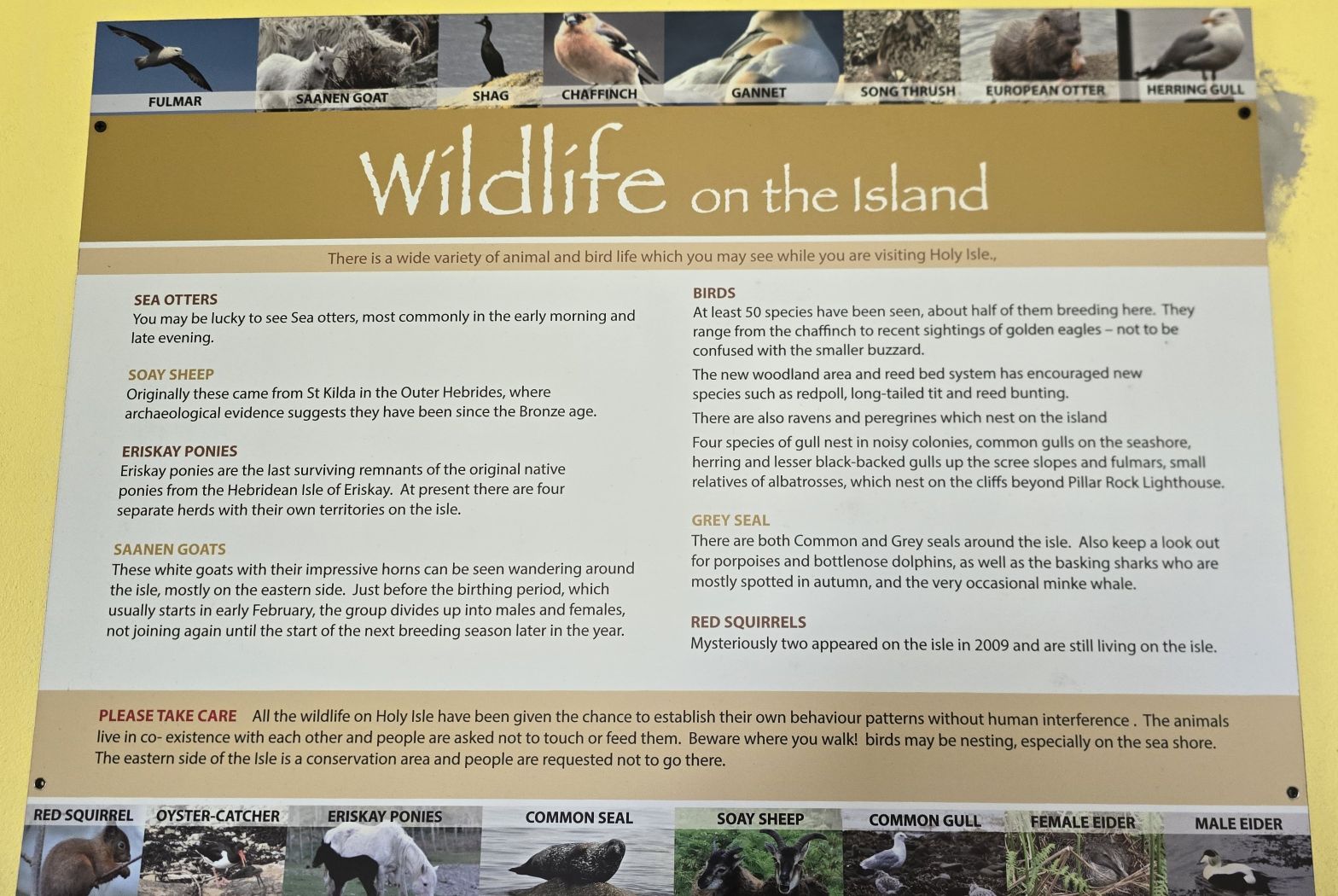
I was feeling very excited to be back. Eriskay ponies, Soay sheep and Saanen goats are the large mammals who live on Holy Isle, and I was hoping we’d be lucky to see them close up today. The animals live peacefully in different herds within their own groups and without human intervention.
Off we went, sailing to Holy Isle again exactly one year later. It has been a quick year!
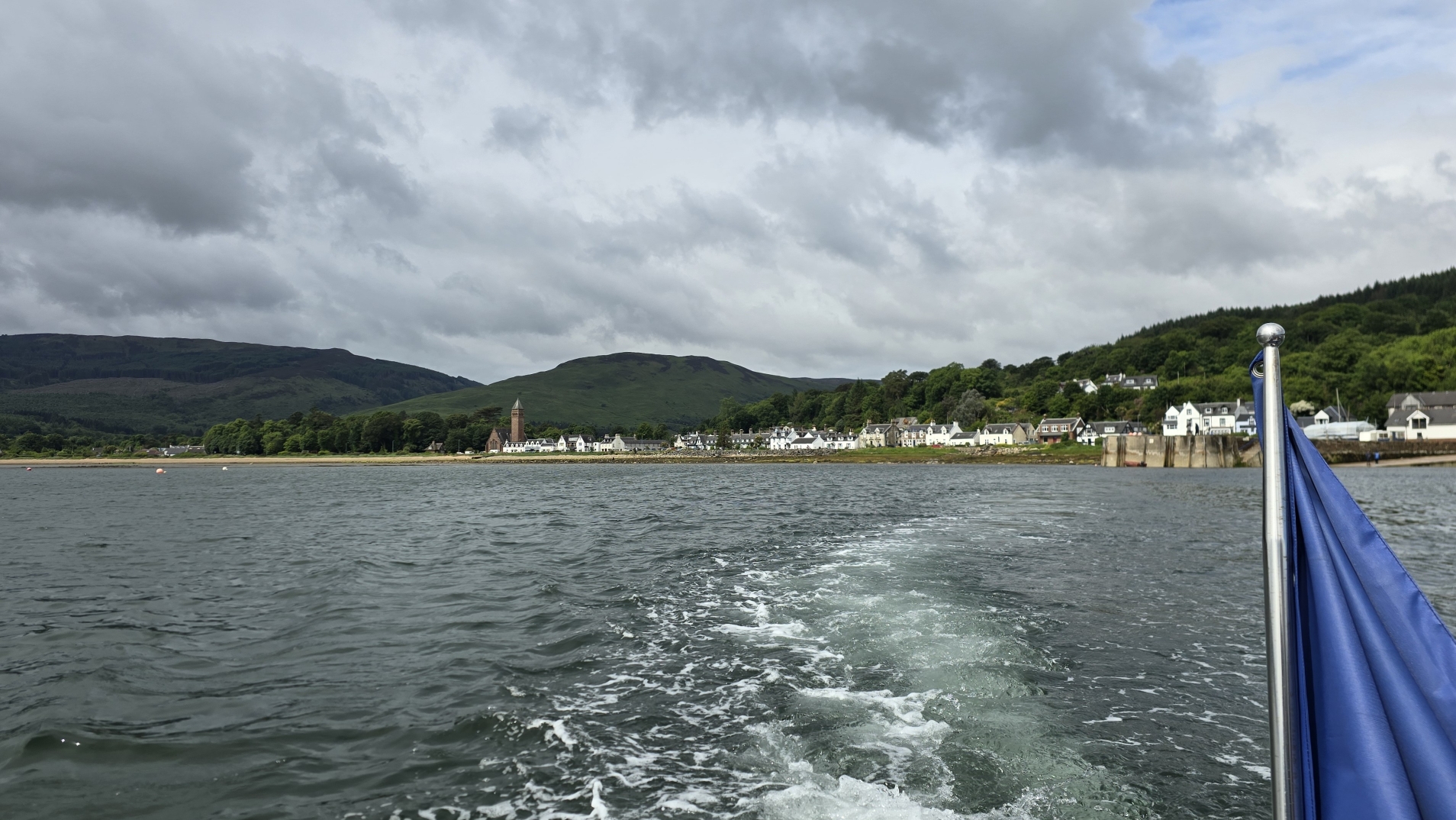
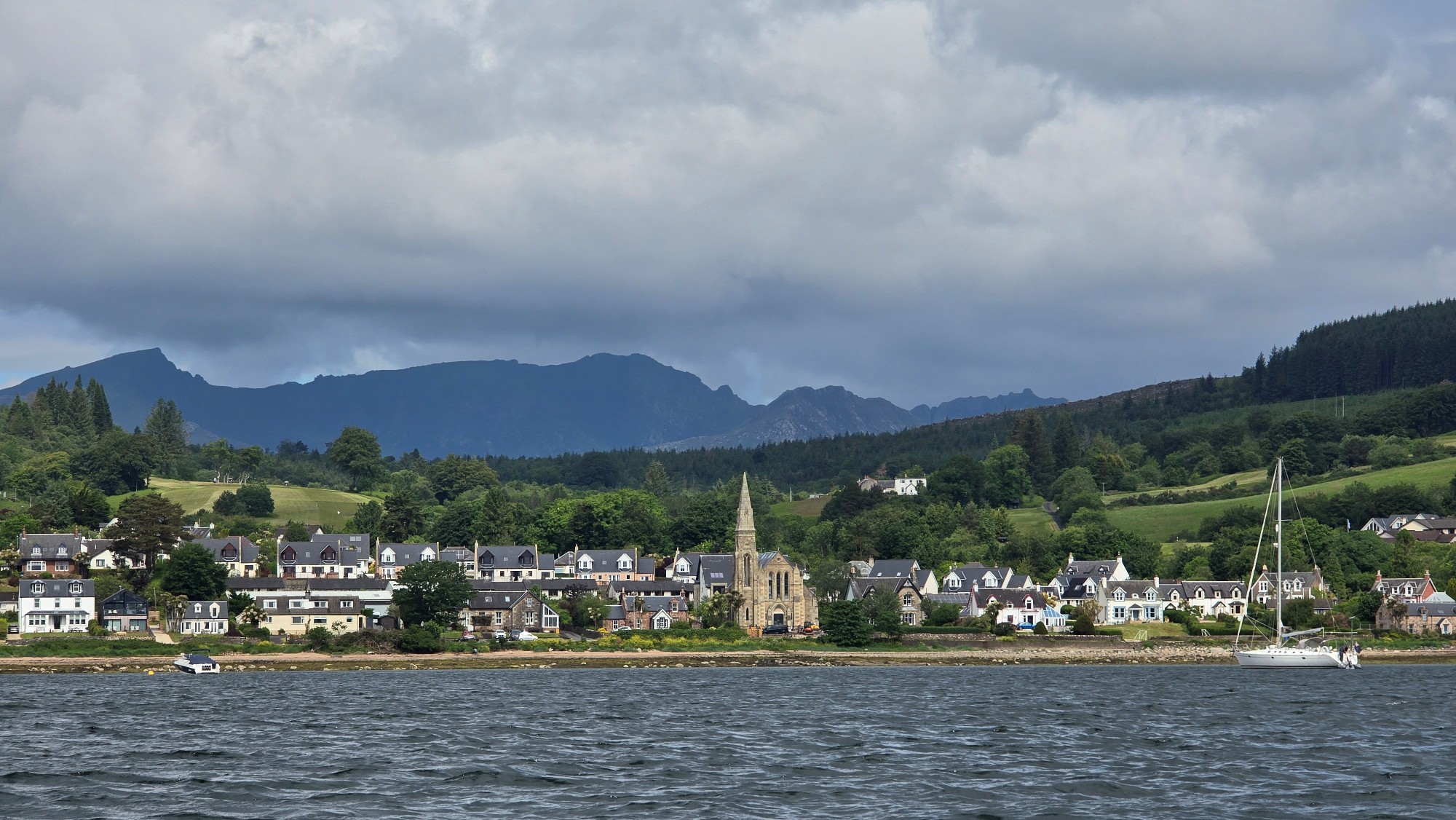
The further away we sailed from Lamlash, the view slowly opened up and I could see a peek of the northern Arran mountains. Being out at sea looking back at the land opens up a whole new perspective of a view. I zoomed in using my phone camera to capture the photo below.
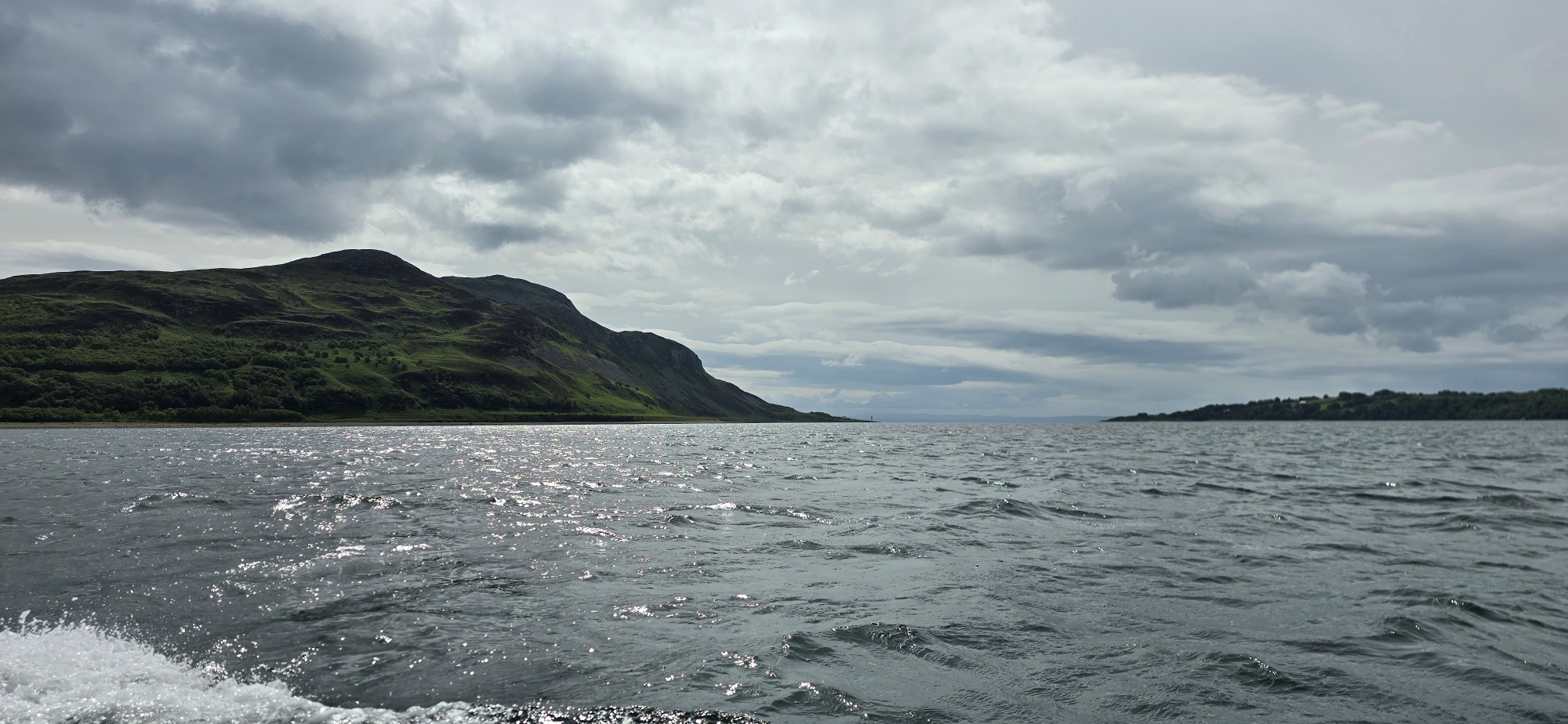
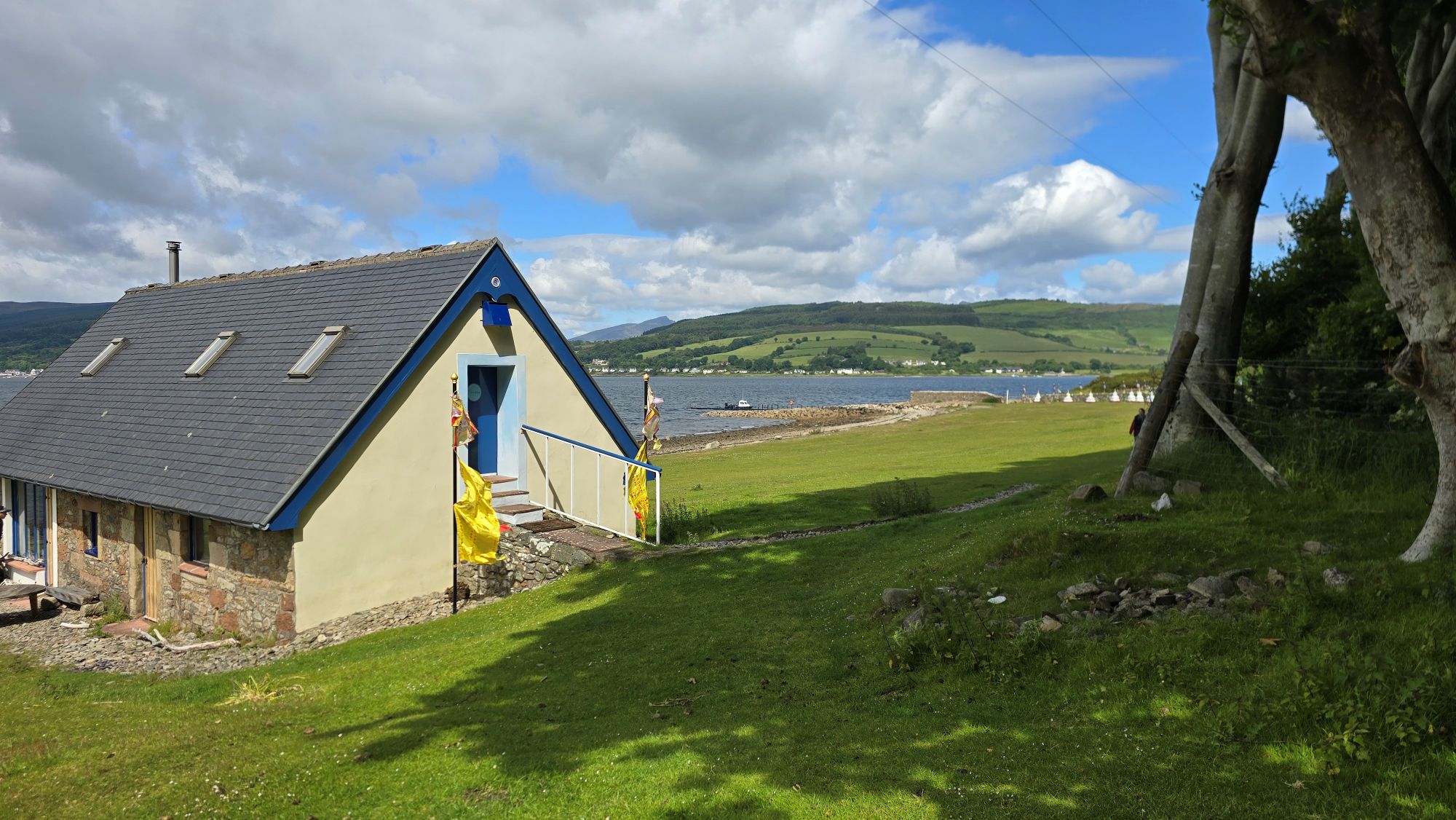
After around a 15-minute sailing we landed at the Holy Isle jetty and gathered around the information sign beside The Centre for World Peace and Health.
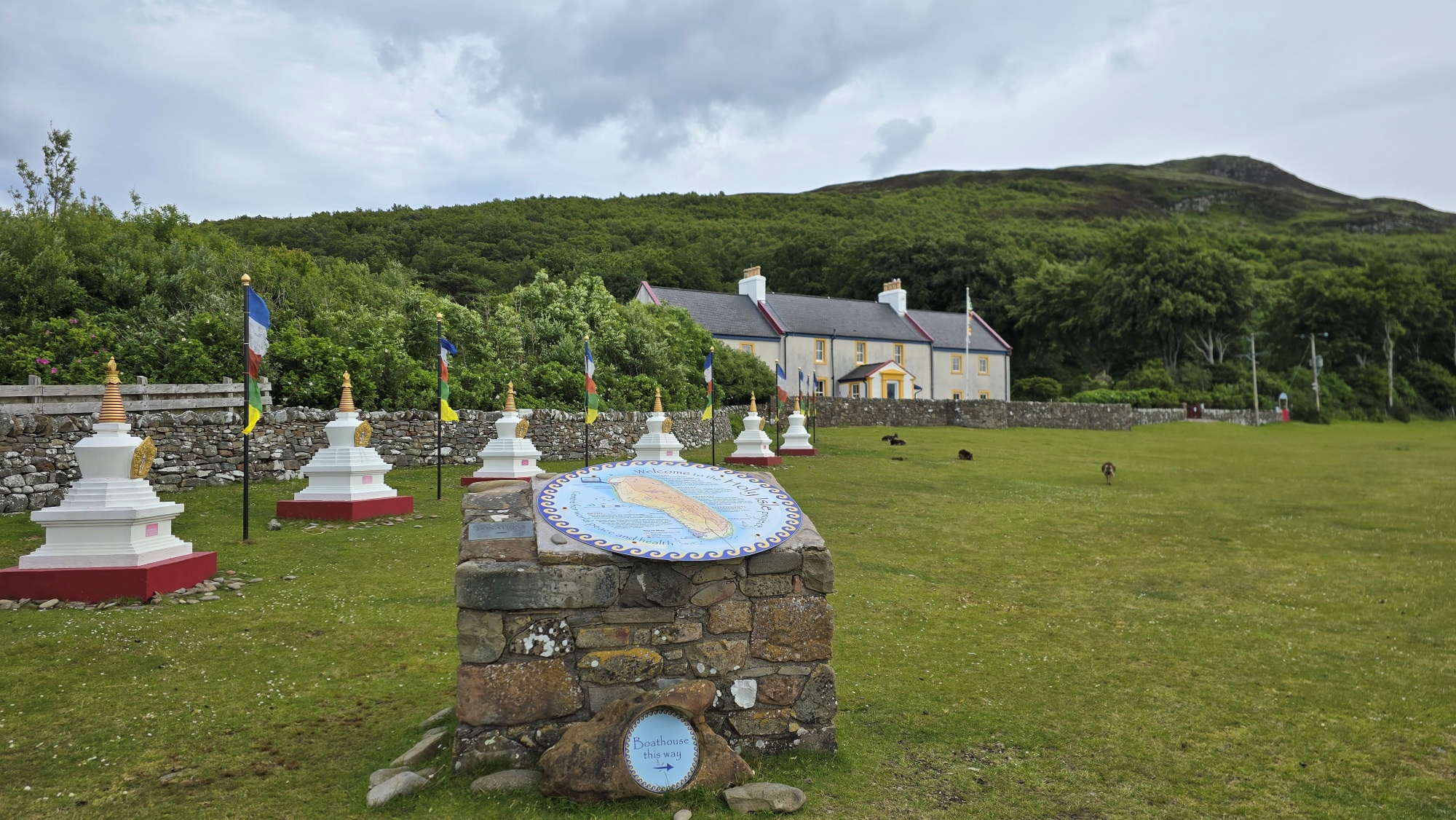
We had a quick talk about the island, its history, and where we were allowed to explore. It is important to respect the privacy of the residents living here, and the guests who are on retreat courses in the Centre.

It was soon time to head off and explore the island. Two members of the group were hiking up to Mullach Mòr, and the rest of us were exploring the coastal walk to the south of the island.
We walked up towards the Information Centre first and had a quick peek inside. The building was previously used as living quarters, classroom, barn and boathouse but is now a space to chill.
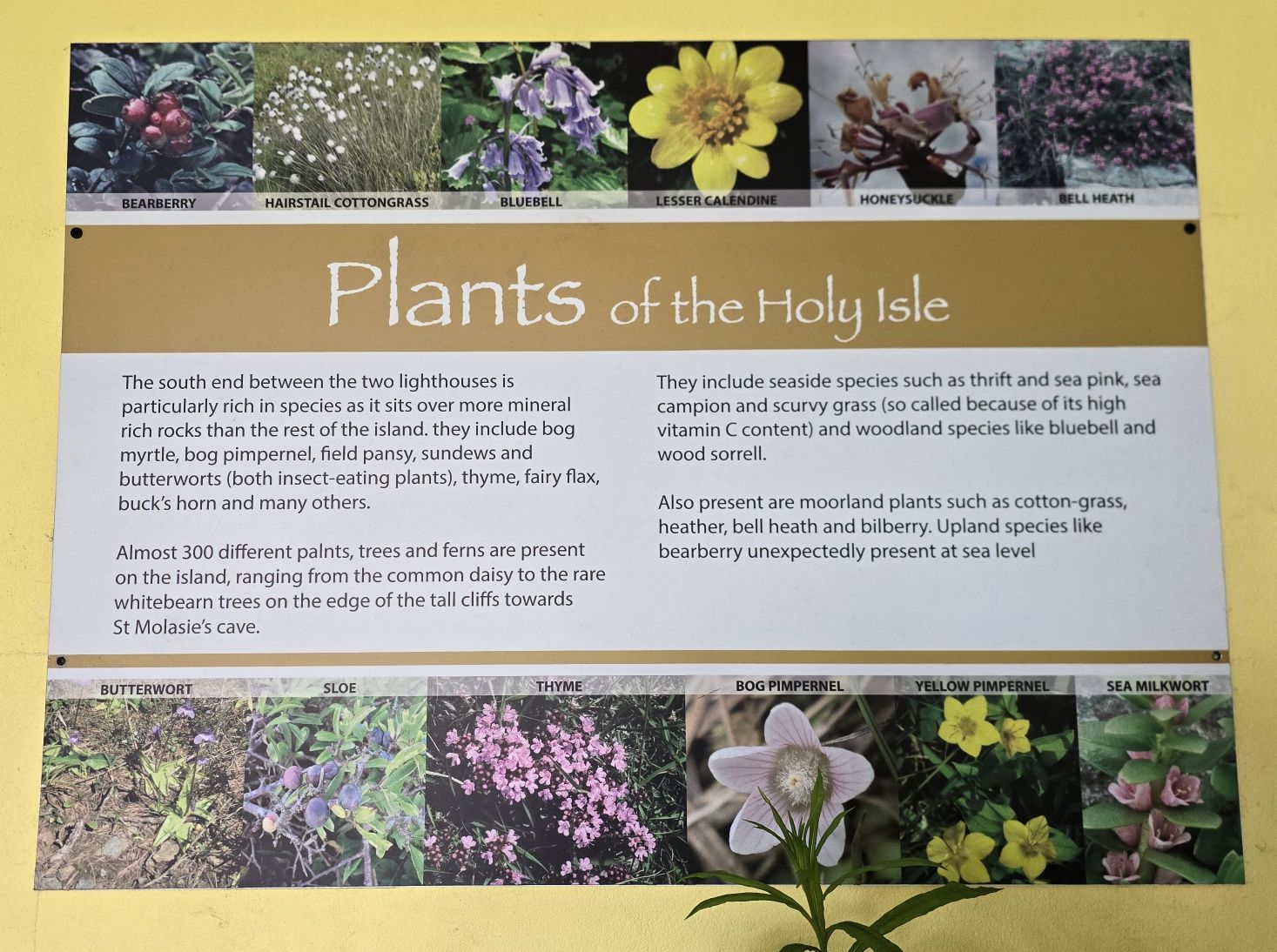
We didn’t stay long and only took photos of the information signs about the wildlife and plants on the island.
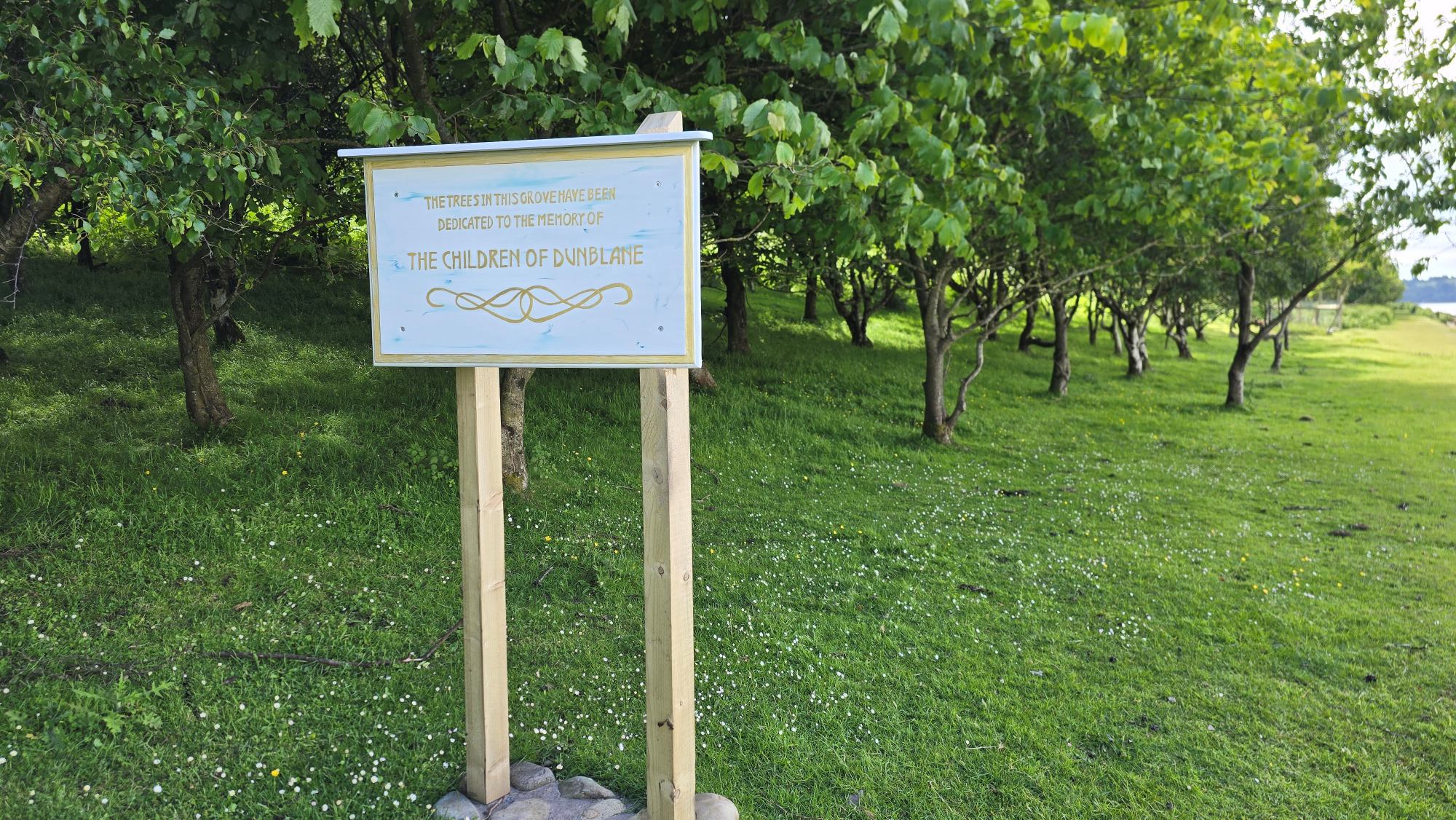
As I walked past a grove of small trees, I experienced a sad moment. These trees are dedicated to the memory of the children who lost their lives in Dunblane in 1996.
Soay sheep
Then all of a sudden, we had our first close up encounter with the Holy Isle wildlife. Three brown Soay sheep, two adults with a little one in tow were walking swiftly along the grass through the small shaded woodland of trees. 🤎
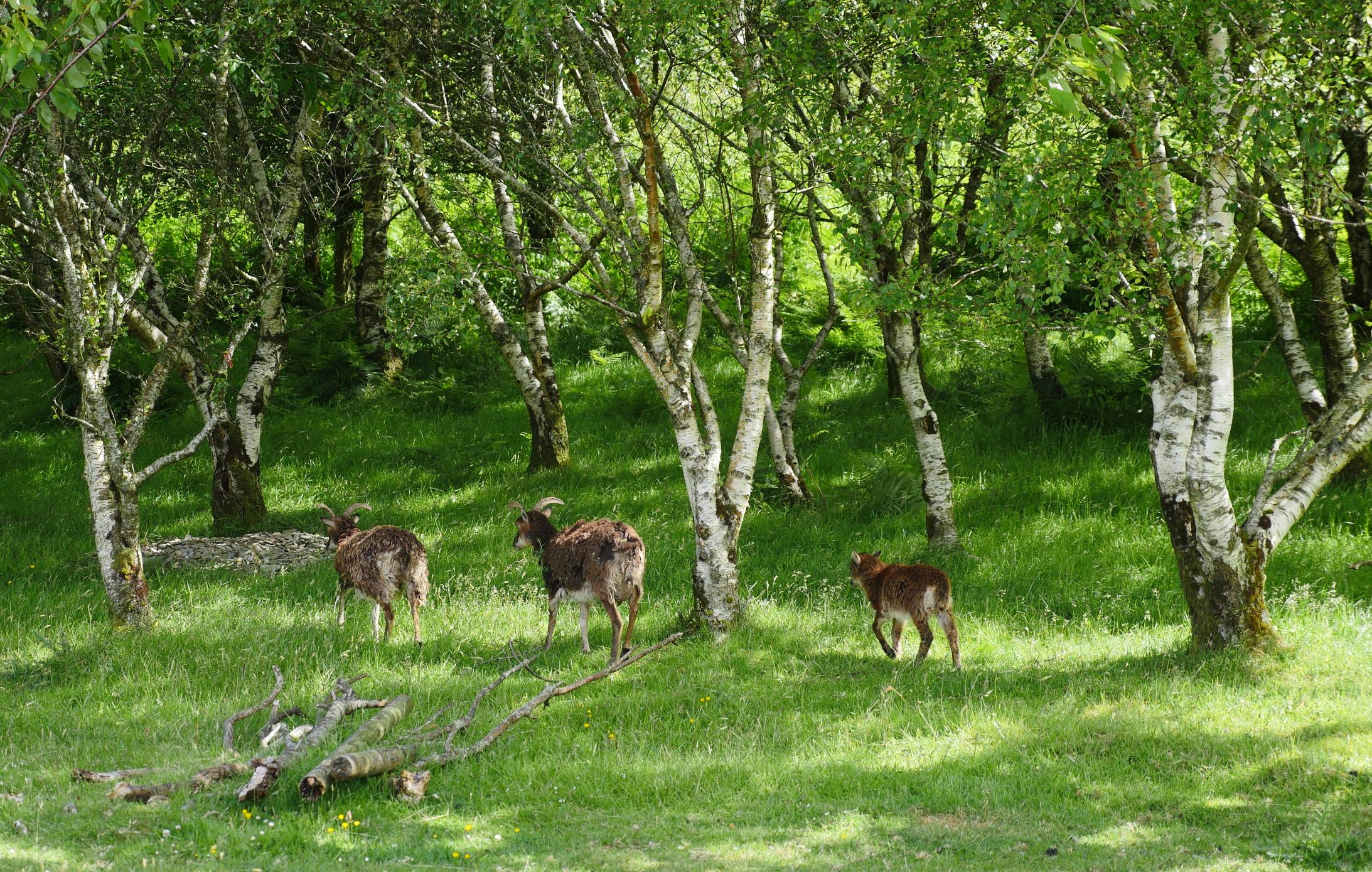
The information sign I read earlier said that Soay sheep are an ancient breed and one of the smallest in the UK. They are a lovely colour of brown with a white belly, named after the uninhabited Soay island, which is part of the St Kilda archipelago in northwest of Scotland. Soay is also Norse for ‘sheep’.
Saanen goats
As we continued to walk along the coastline path, I heard and saw movement amongst the tall bracken at the side of the footpath. Young Saanen goats were hiding in the tall bracken, and I could see little horns and white faces curiously peeking up. Oh my, how cute is this!

Saanen goats are said to have been brought to Holy Isle 700 years ago by the Vikings. They have lovely white coats and long horns. Their coats look so white, and I was wondering how they keep it so clean. Lots of grooming I expect!
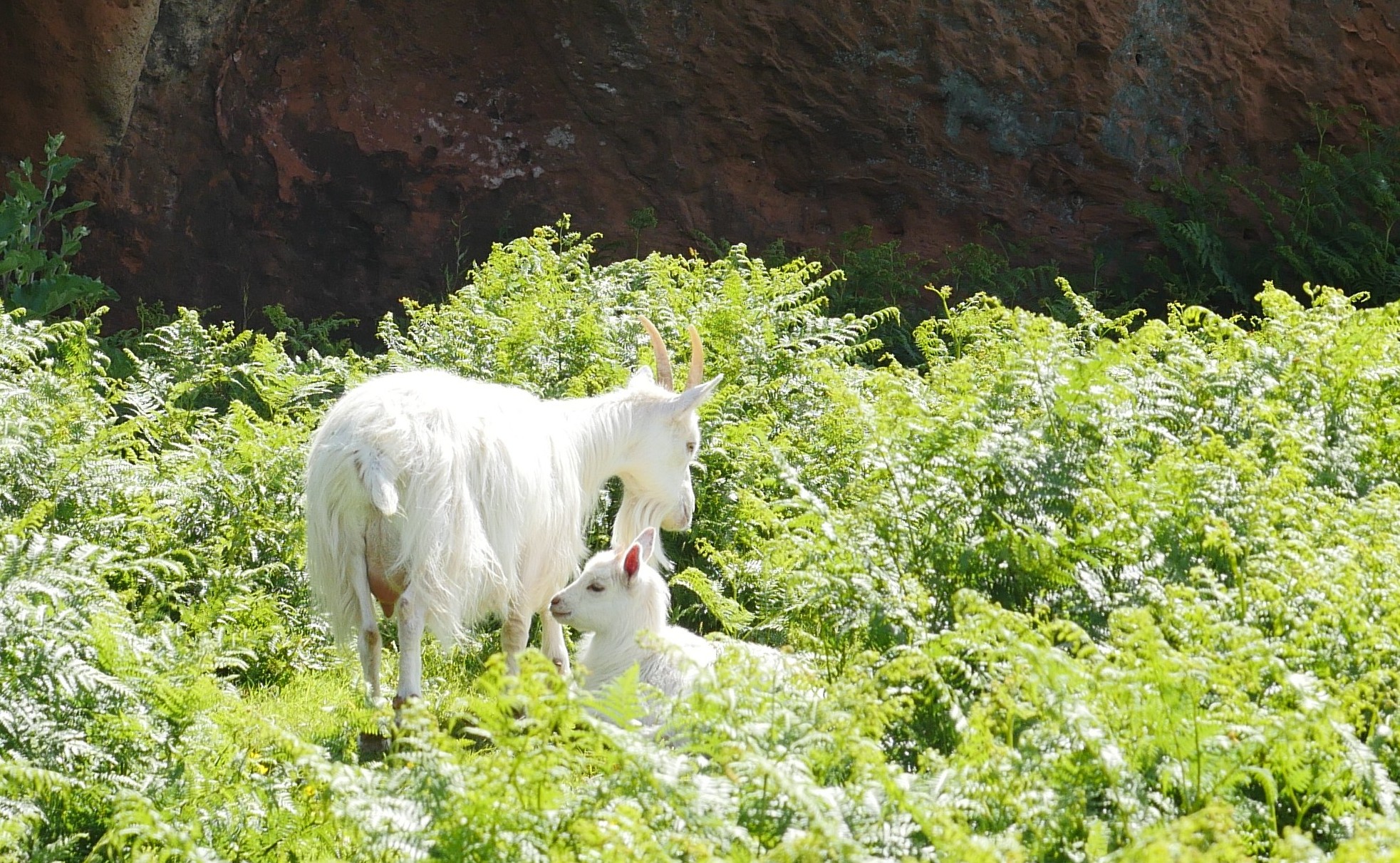
These two must be mother and child. The little one curiously looked straight at me, staying close to mum of course. It looks like it’s smiling at me. 🤍
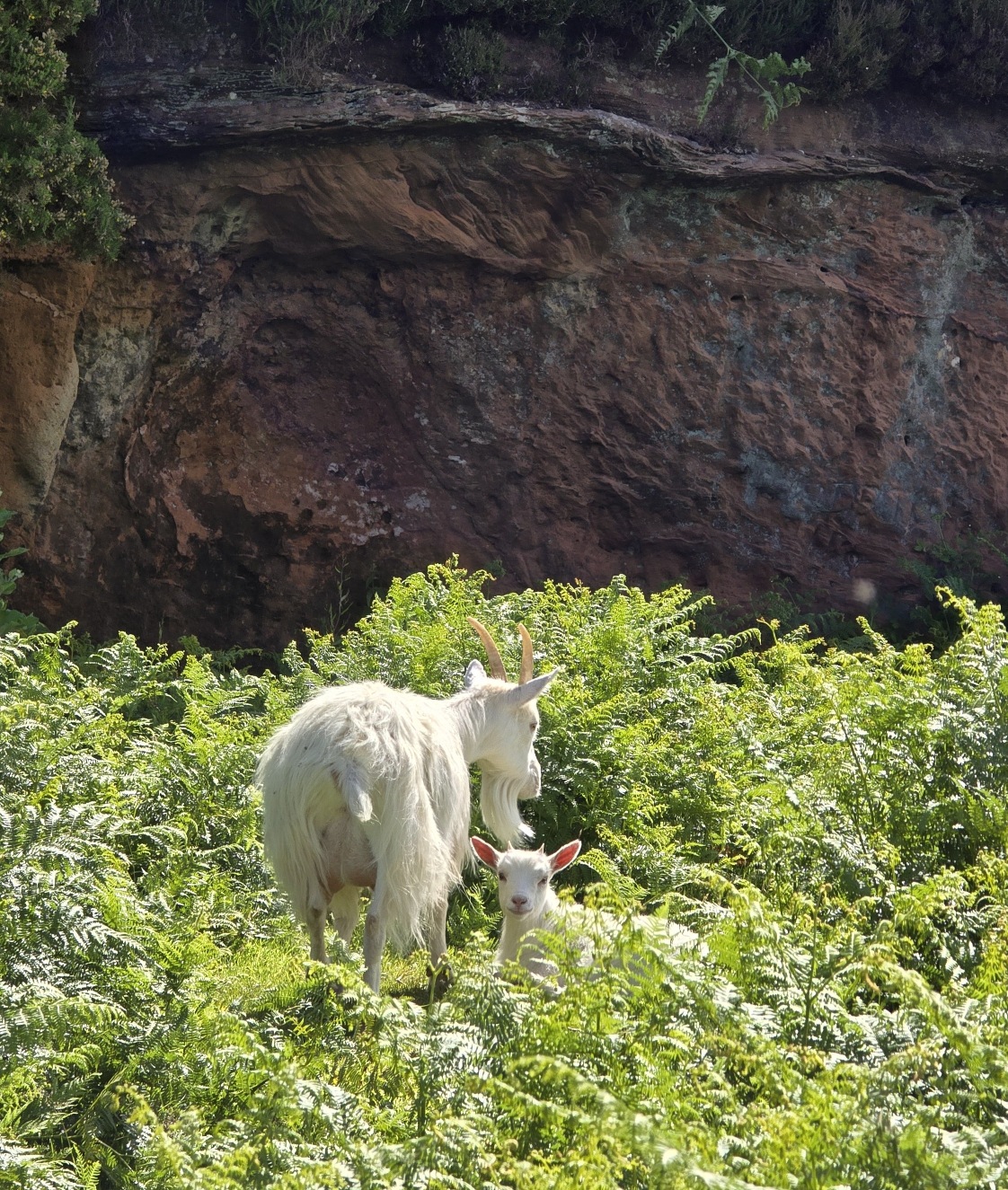
We saw even more goats along the coastal walk, so apologies in advance for all the goat photos. I love them!
Holy Isle plants
We found Holy Isle plants amongst the bracken, but we didn’t spend too much time looking for the others that were listed in the Information Centre. The flowers seemed to randomly appear in small clusters amongst the foliage, and so pretty.
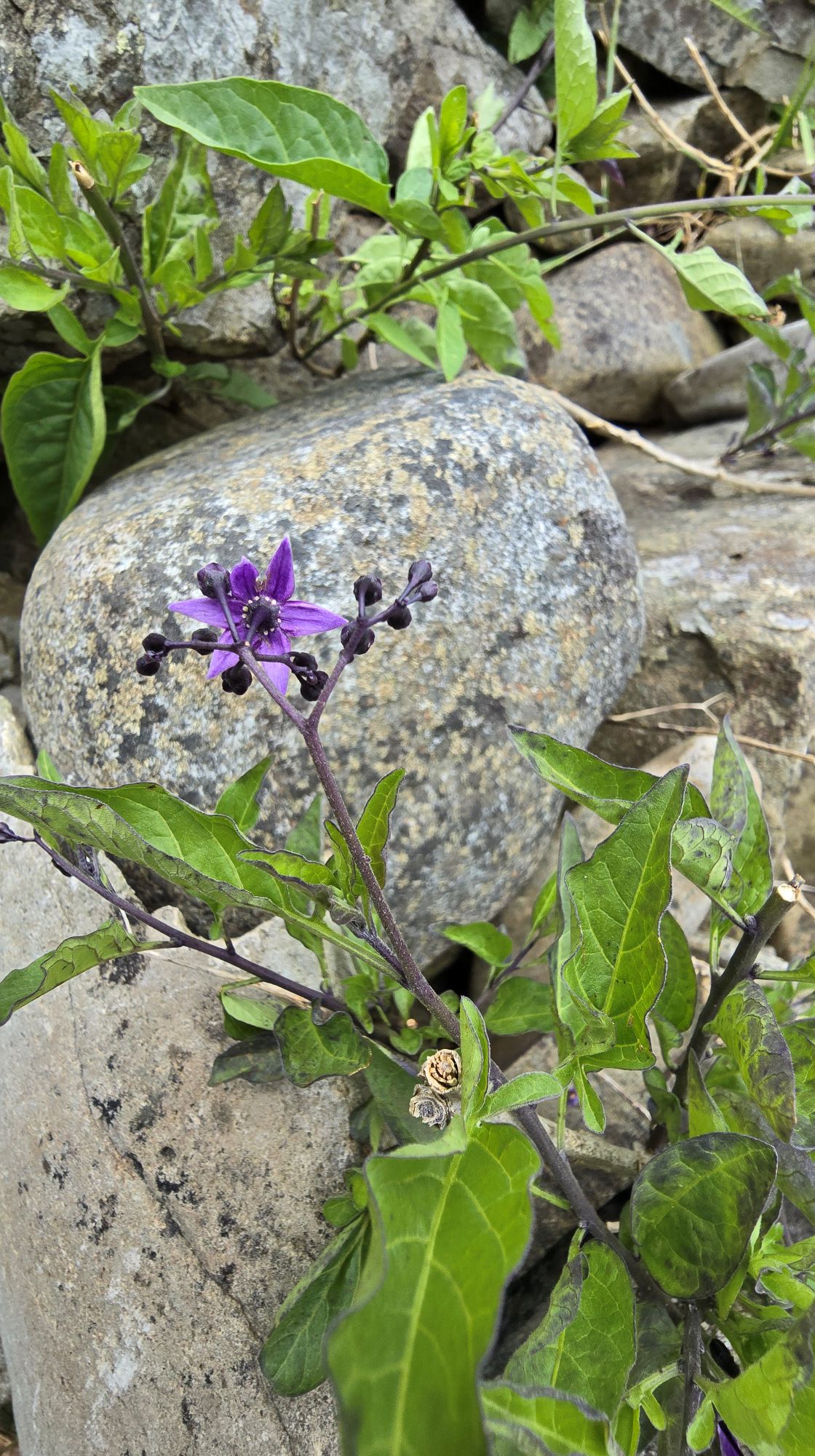
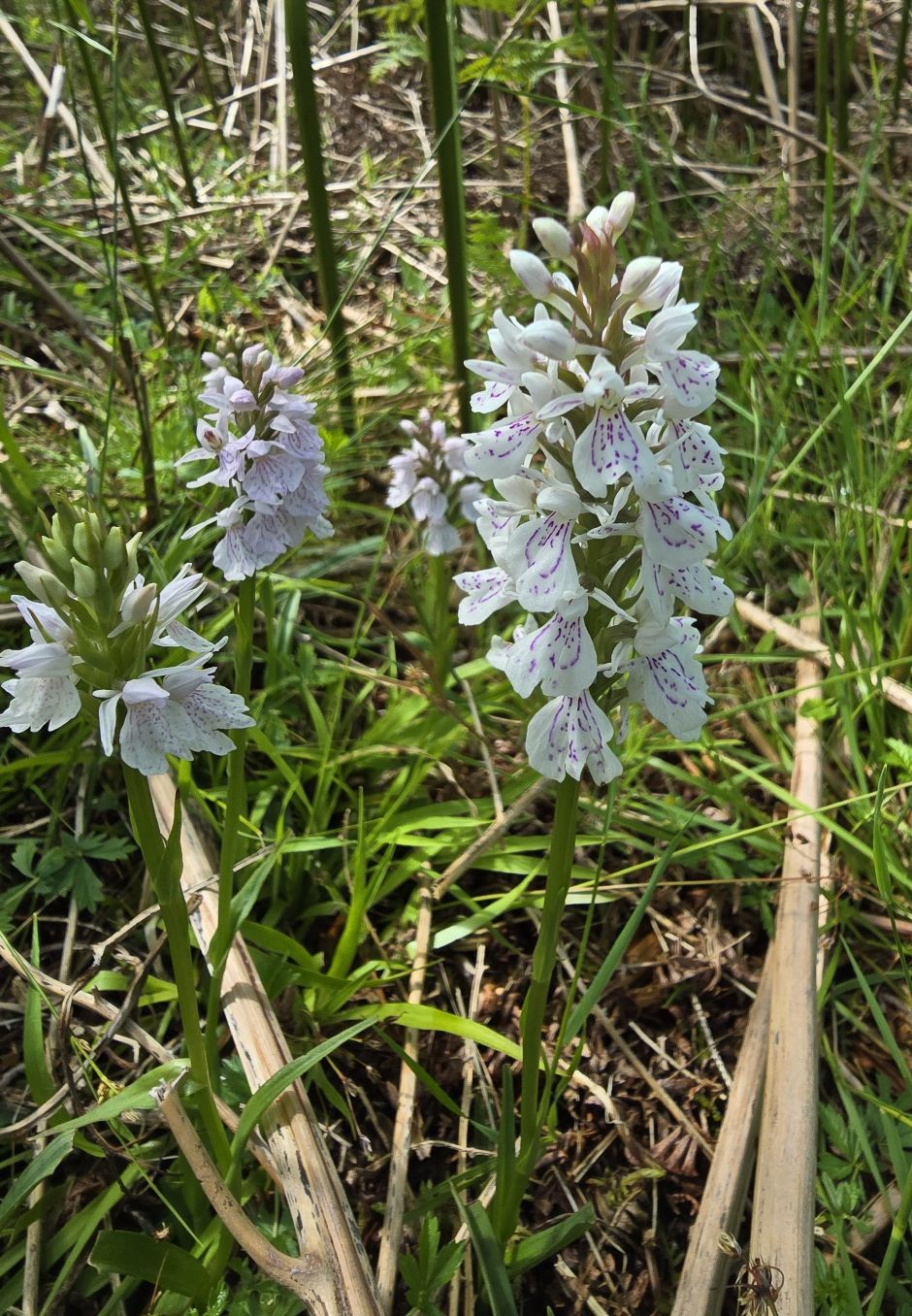
One of the names for the dark purple flowered plant is ‘Bittersweet’ and the white and lilac flowers are ‘Heath Spotted Orchids’, according to the ‘Picture This App’ I use to identify flora.
Holy Isle coastline views
The further we walked along the coastline, more of the Isle of Arran came into view showing off its own natural beauty with a backdrop of open blue sky and white puffy fluffy clouds. I never know whether to describe clouds as ‘puffy’ or ‘fluffy’, both words seem to work though. 😂
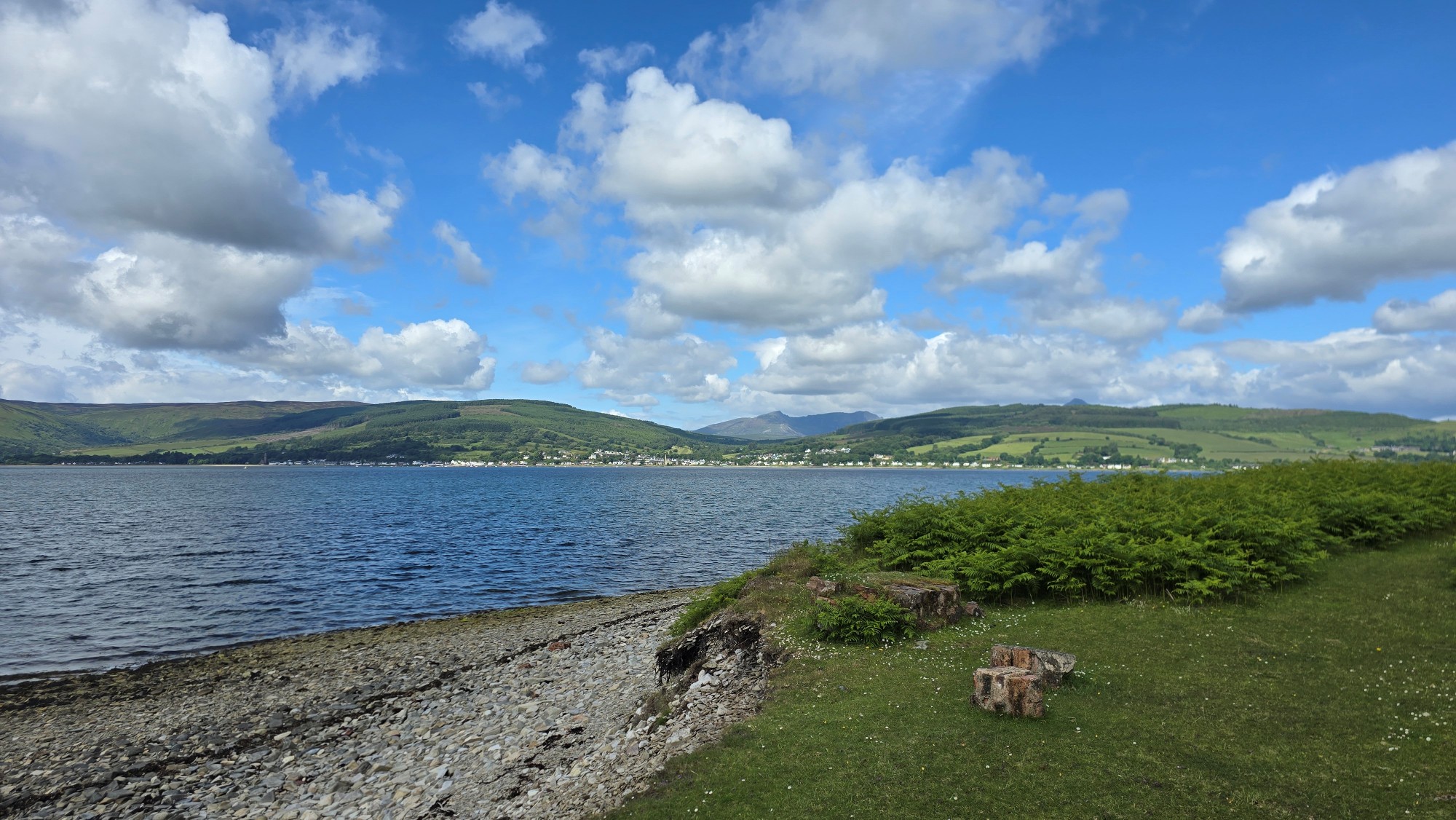
Views like this just make me feel so alive and grateful to be where I am at that moment in time.
I stopped and turned around to wait for Alan, still admiring the view as he walked towards me. I knew we were stopping too often already but it was difficult not to as walking on Holy Isle is so peaceful and naturally beautiful! The island should be enjoyed at a slower pace.
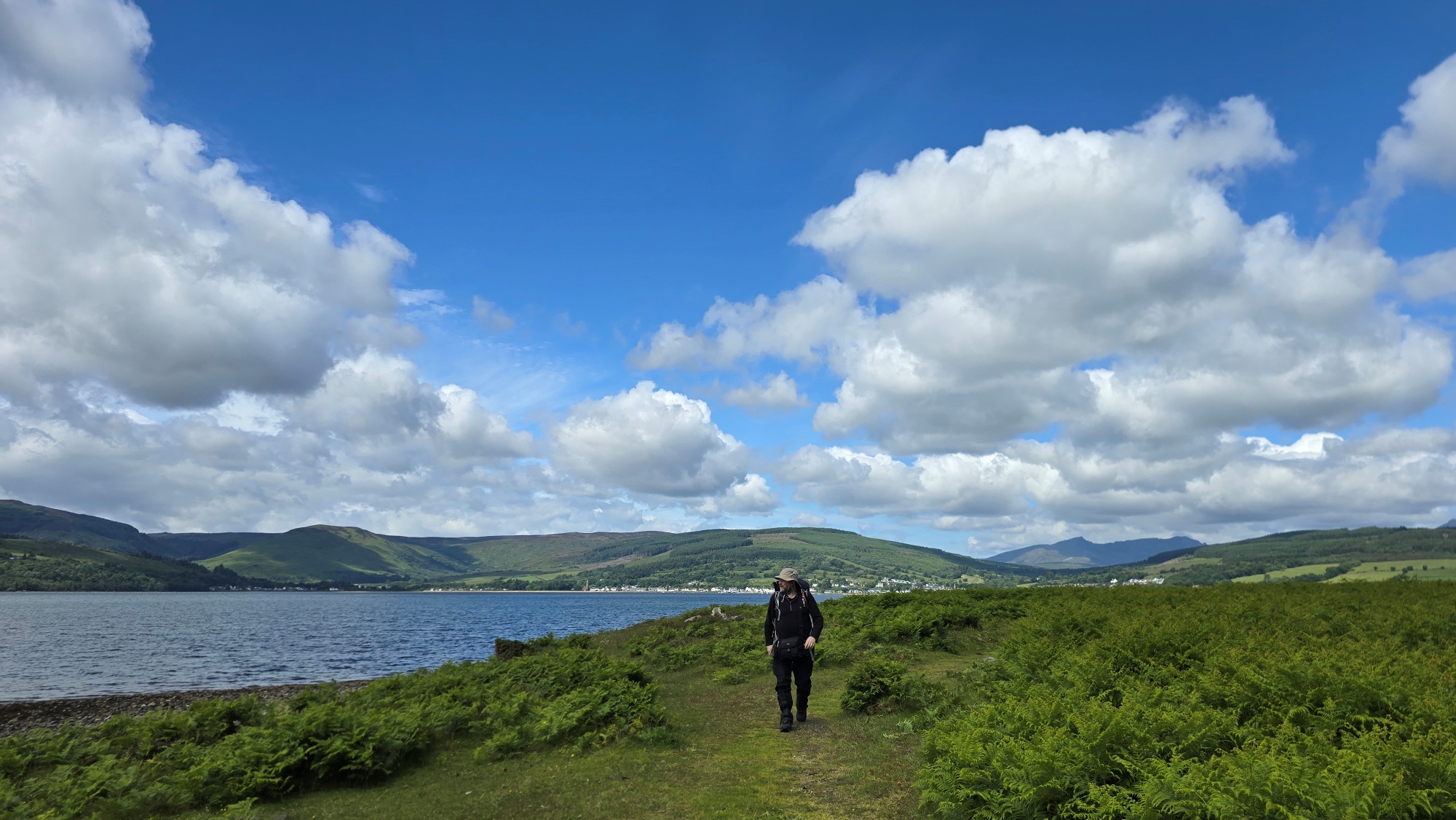
The earliest recorded name for Holy Isle was Inis Shroin, an old Celtic name meaning ‘Island of the Water Spirit’. I love this name, it sounds so mystical.
I was wishing I could stay here all day and after exploring I could find a place to sit quietly, listen to the waves and watch the ever-changing sky and light until sunset.
As I continued walking along the well maintained grassy footpath through the avenue of bracken, the rugged hills and coastline ahead reminded me of the Ayrshire coastline walk near the Heads of Ayr and Bracken Bay, with dramatic high cliffs and Jurassic feels.
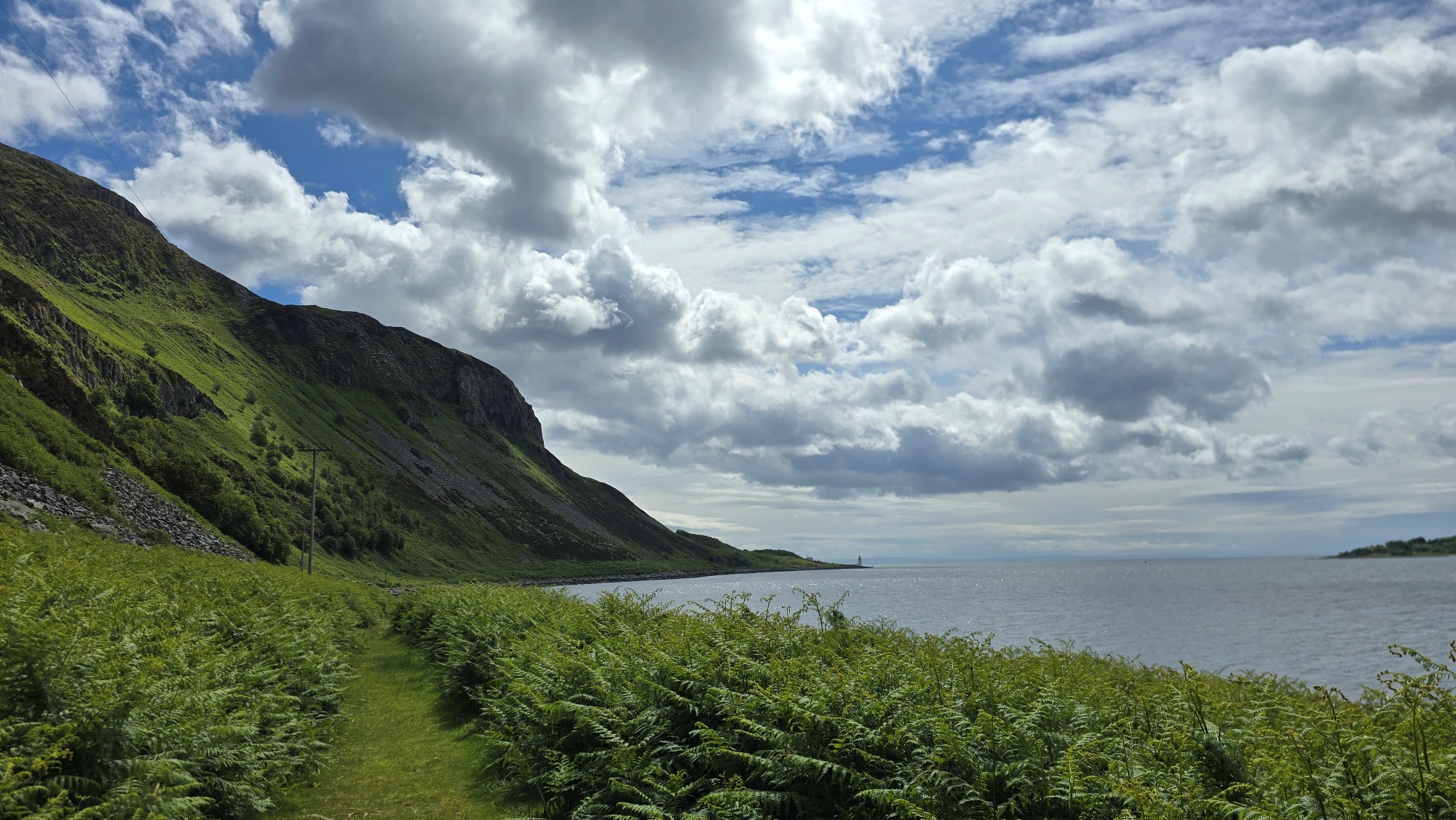
When my eyes gaze upon a real-life picture like this, words are often not descriptive enough to describe the moment. My talk out loud words are usually: “Oh wow, look at that, it’s so beautiful.”
At the same time, I’m also creating feelings of calm and happiness, in awe of my surroundings and excited to see what else lies ahead. My inner mind and body ‘feel’ the scenery completely different, like a deep magical feeling of the unspoken word.
I looked up at the high cliffs to the left of me and was wondering how the couple hiking to the top were getting on. They would have superb views today that’s for sure!
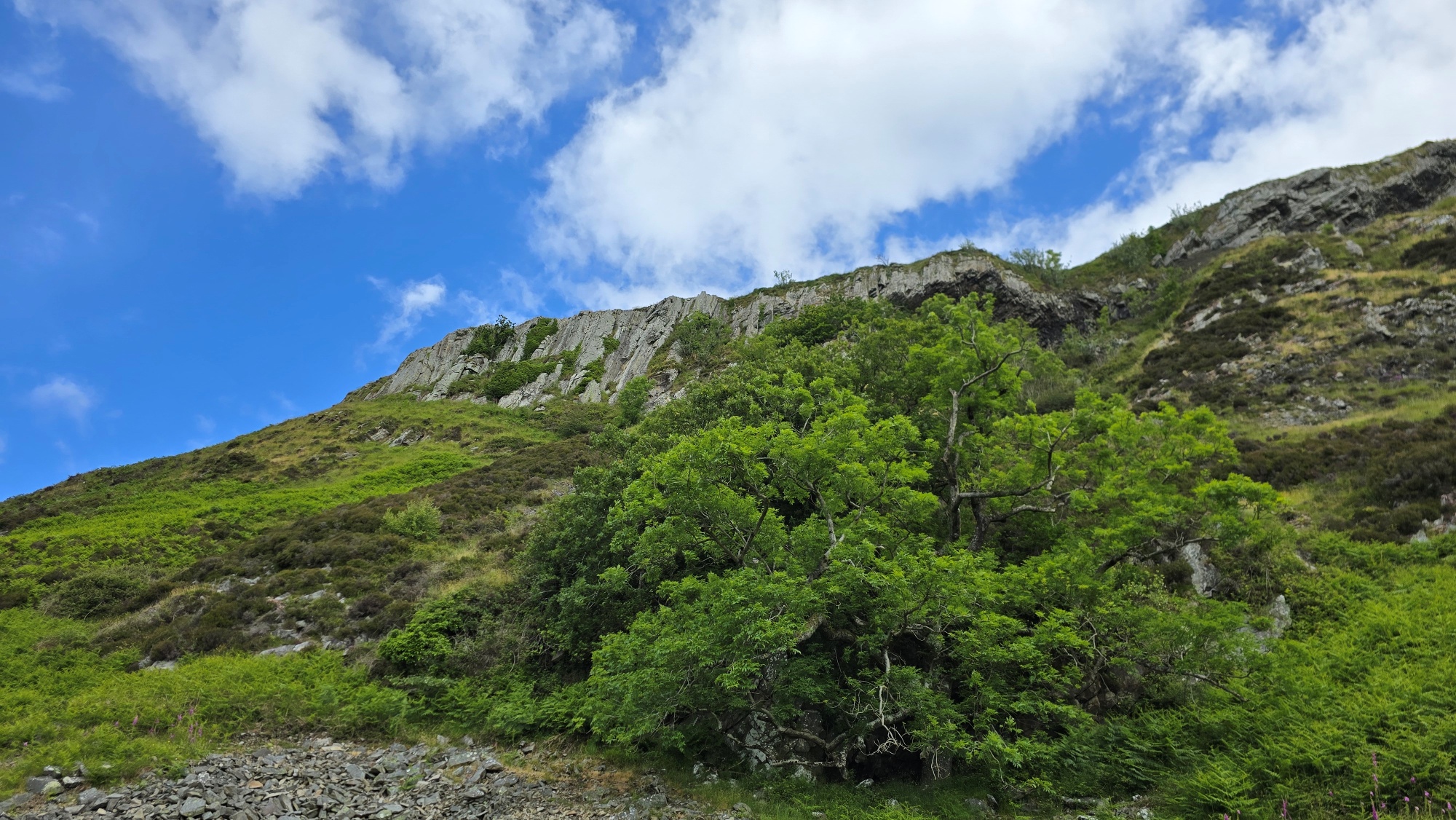
Saint Molaise’s Cave
We could just about see the rock sign pointing to Saint Molaise’s Cave, hidden amongst the tall bracken, or is it fern?
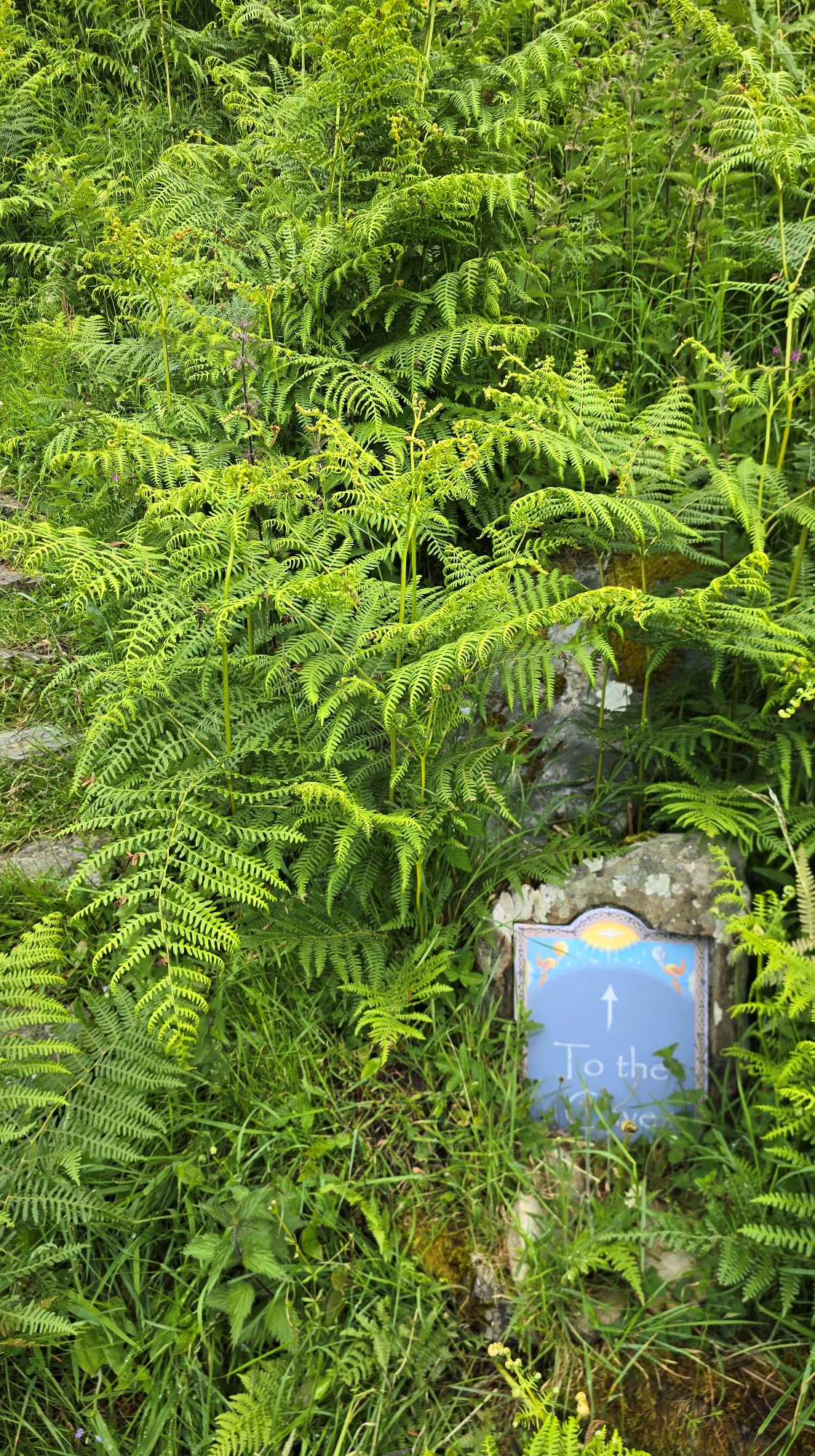
As I was writing this I began to wonder if there’s a difference between bracken and fern. In my mind they are both the same, but after researching I found out they are slightly different in roots. I really should read more to expand my knowledge about flora!
Fern has multiple stems growing out of the same root system, creating a cluster of leaves. Fern has friends. 😊
Bracken is one single stem growing out of one root system, with side stems like branches from the main stem. The stem sits on its own can grow over two metres tall. Bracken has no friends. ☹️
The Woodlands Trust website also says that burnt bracken ash can be used to make glass, soap and as a plant fertiliser and weed control.
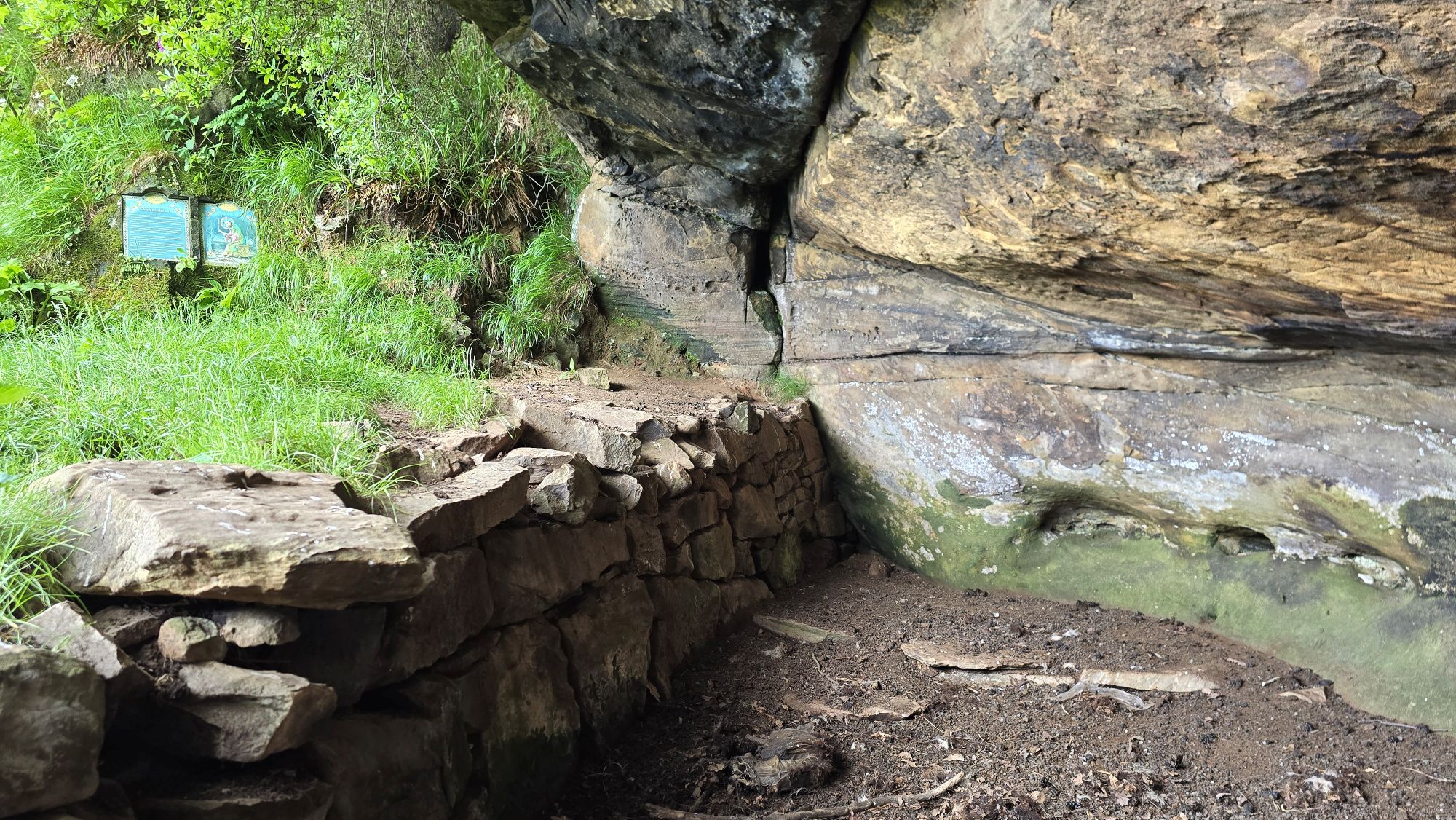
It was a short incline up the stone steps to Saint Molaise’s Cave, an overhanging sandstone alcove-like cave with a few steps leading down inside it. It’s not very deep, but wide.
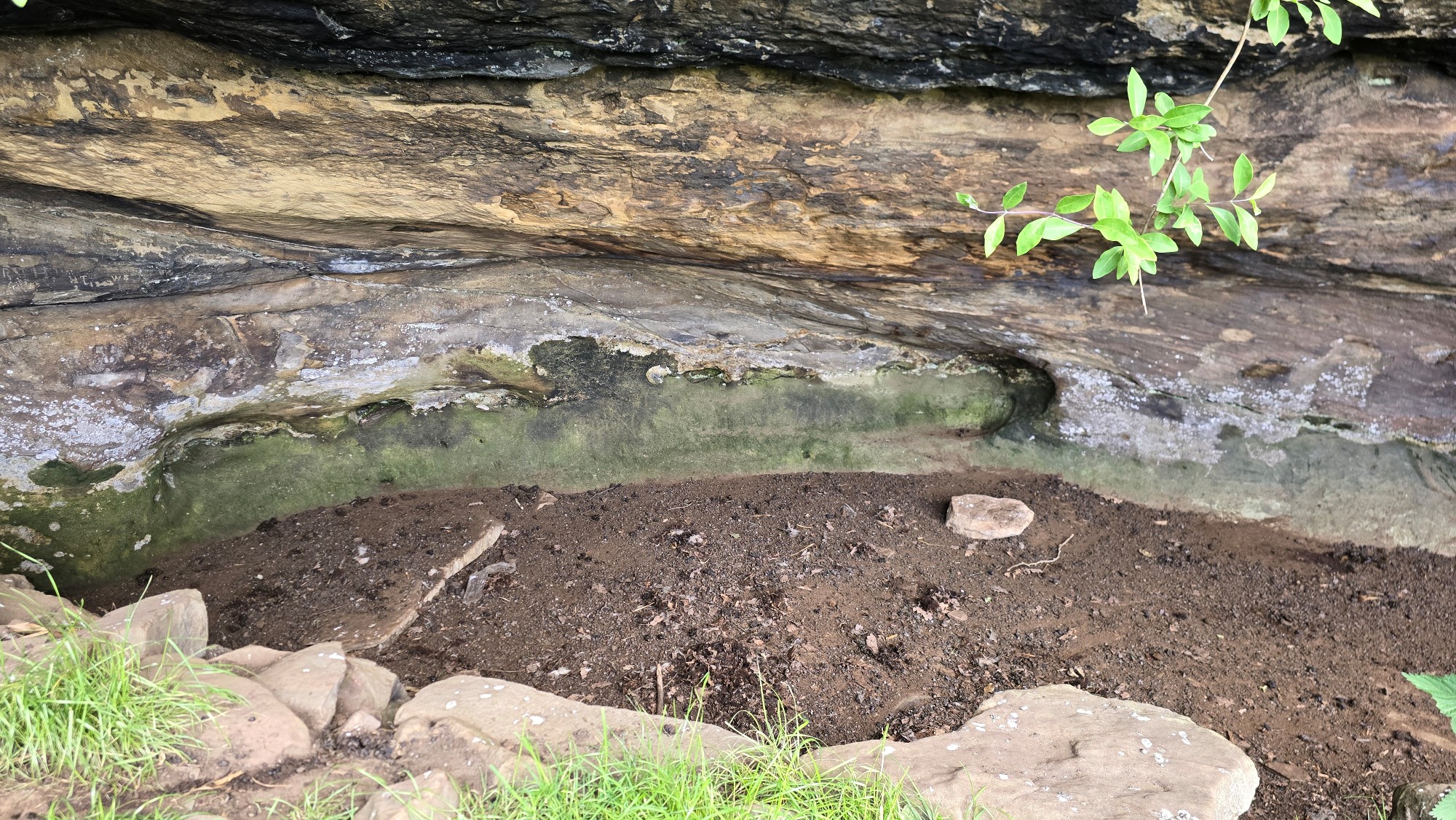
The Canmore website have recorded the cave as 38.5 feet long by 13 feet at its widest, near the stone steps.
I noticed an unusual plant growing out of a little sandstone nook and was surprised that it could thrive in such a shaded environment.
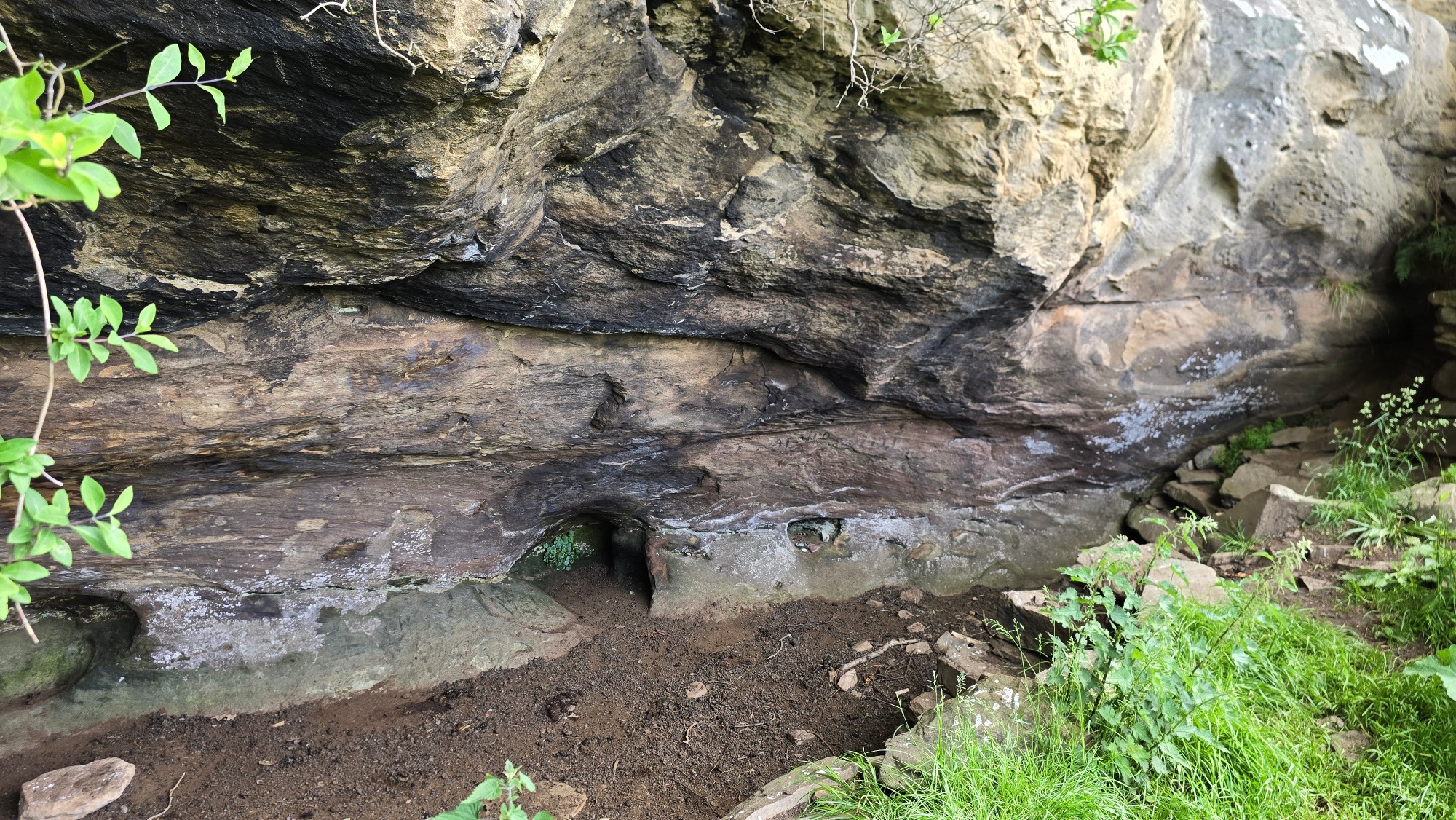
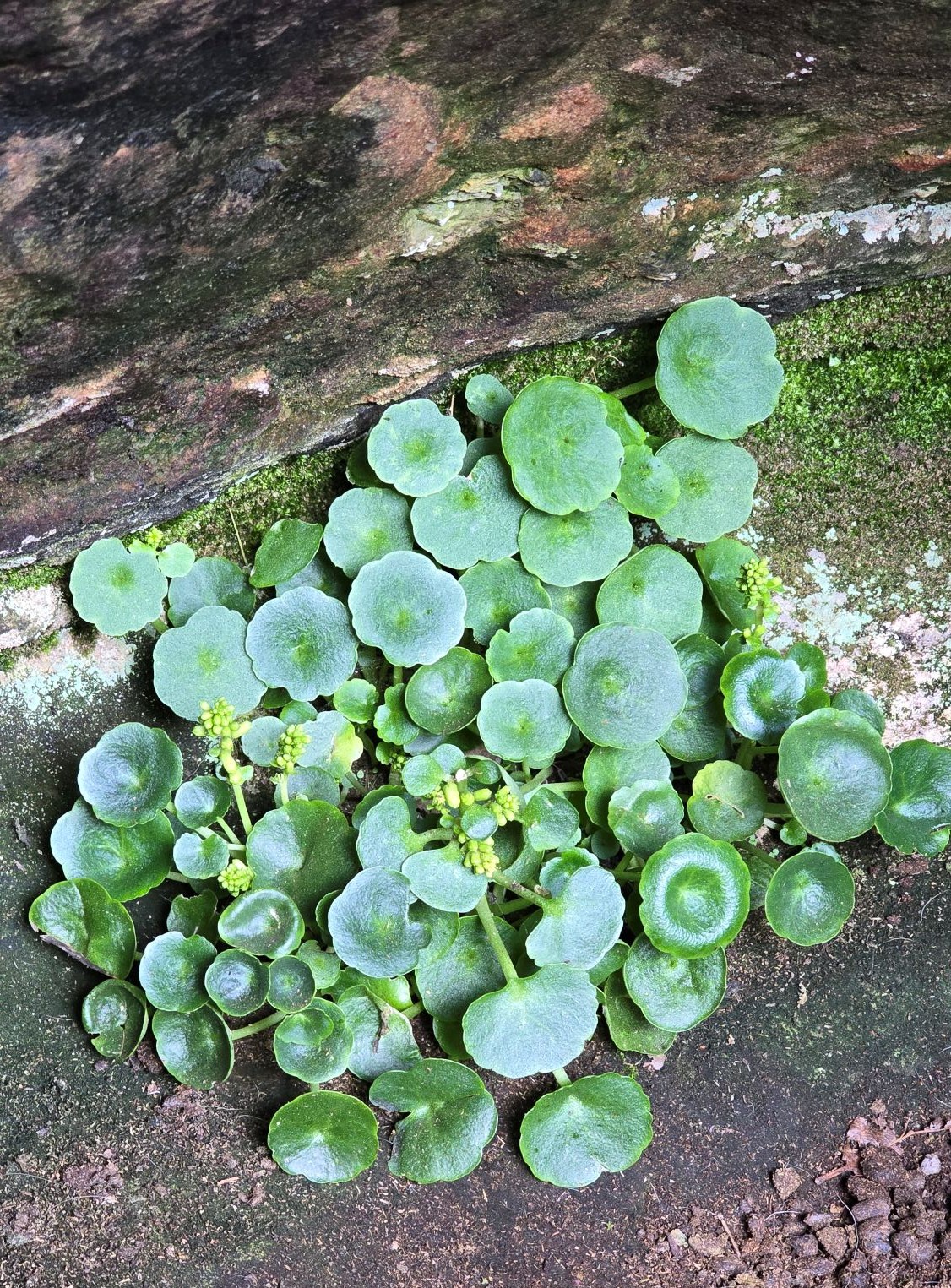
Researching on the app I mentioned earlier, the plant is called ‘Navelwort’, but also known by other names such as:
- Penny-pies
- Wall pennywort
- Pennywort
- Kidneywort
- Rock navelwort
Oh, I love the name ‘Penny-pies’! Looking at the other names, maybe this is why it grows out of rock walls. The evergreen herb plant thrives in full sunlight, but will tolerate partial sunlight too, and it likes sandy soil. I wondered if the sun reaches the little nook at some point in the day.
The cave is named after Saint Molaise, pronounced as ‘Mo-lash-eh’, who was born in Ireland in the sixth century as Prince of Ulster. Rather than becoming the King of Ulster on his father’s death, when he was 20 years old, he chose a religious and secluded life in this cave for 10 years.
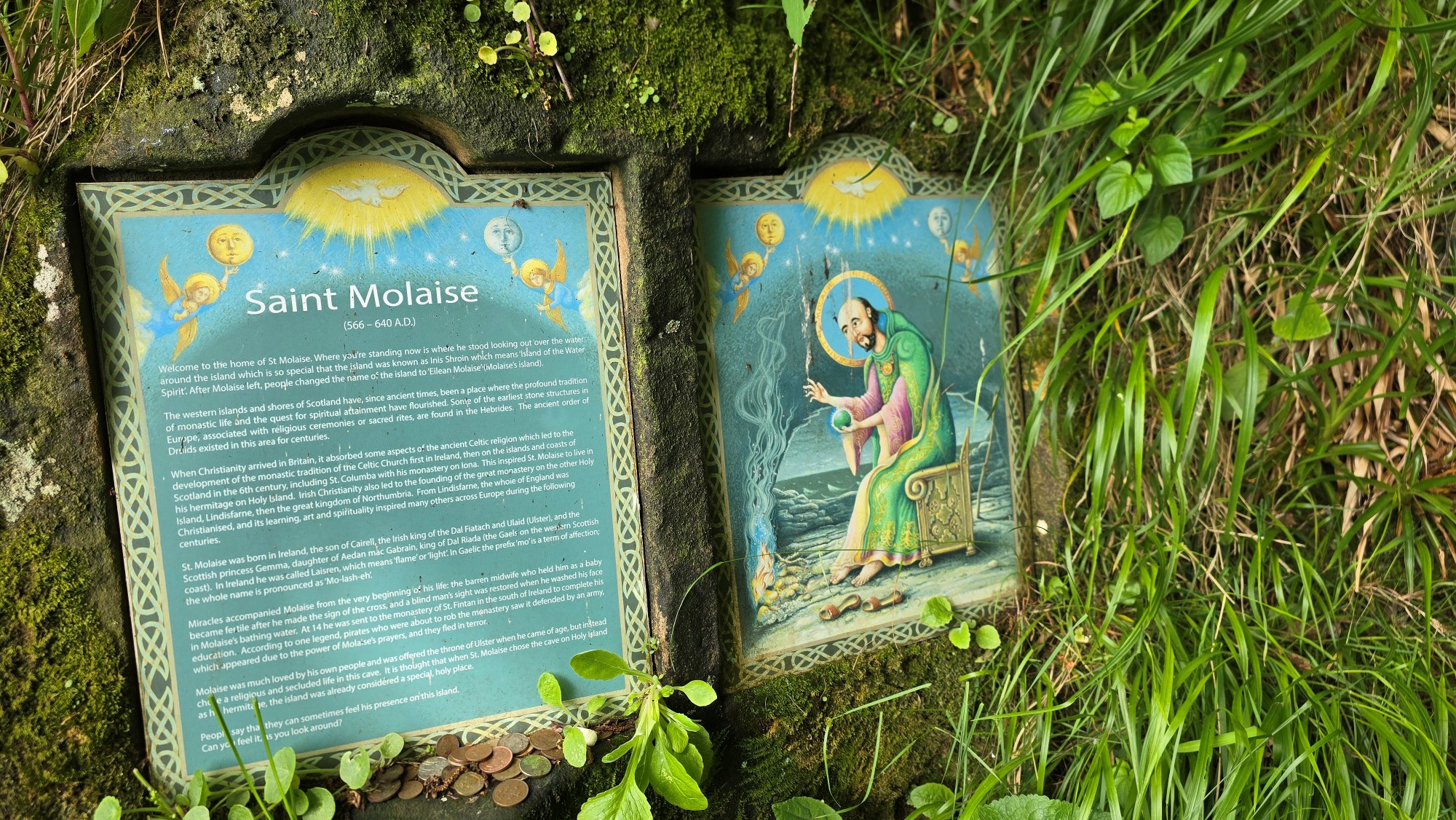
The information sign reads:
Saint Molaise
(566-640 AD)
Welcome to the home of St Molaise. Where you’re standing now is where he stood looking out over the water around the island which is so special that the island was known as Inis Shroin which means ‘Island of the Water Spirit. After Molaise left, people changed the name of the island to ‘Eilean Molaise’ (Molaise’s island).
The western islands and shores of Scotland have, since ancient times, been a place where the profound tradition of monastic life and the quest for spiritual attainment have flourished. Some of the earliest stone structures in Europe, associated with religious ceremonies or sacred rites, are found in the Hebrides. The ancient order of Druids existed in this area for centuries.
When Christianity arrived in Britain, it absorbed some aspects of the ancient Celtic religion which led to the development of the monastic tradition of the Celtic Church first in Ireland, then on the islands and coasts of Scotland in the 6th century, including St. Columba with his monastery on Iona. This inspired St. Molaise to live in his hermitage on Holy Island.
Irish Christianity also led to the founding of the great monastery on the other Holy Island, Lindisfarne, then the great kingdom of Northumbria. From Lindisfarne, the whole of England was Christianised, and its learning, art and spirituality inspired many others across Europe during the following centuries.
St. Molaise was born in Ireland, the son of Cairell, the Irish king of the Dal Fiatach and Ulaid (Ulster), and the Scottish princess Gemma, daughter of Aedan mac Gabrain, king of Dal Riada (the Gaels on the western Scottish coast). In Ireland he was called Laisren, which means ‘flame’ or ‘light: In Gaelic the prefix ‘mo’ is a term of affection; the whole name is pronounced as ‘Mo-lash-eh.
Miracles accompanied Molaise from the very beginning of his life: the barren midwife who held him as a baby became fertile after he made the sign of the cross, and a blind man’s sight was restored when he washed his face in Molaise’s bathing water. At 14 he was sent to the monastery of St. Fintan in the south of Ireland to complete his education. According to one legend, pirates who were about to rob the monastery saw it defended by an army, which appeared due to the power of Molaise’s prayers, and they fled in terror.
Molaise was much loved by his own people and was offered the throne of Ulster when he came of age but instead chose a religious and secluded life in this cave. It is thought that when St. Molaise chose the cave on Holy Island as his hermitage, the island was already considered a special, holy place.
People say that they can sometimes feel his presence on this island.
Can you feel it, as you look around?
I didn’t read the full information sign when I was there. I now wish I stayed around for longer to feel what it could be like to actually live and sleep here, listening to the sounds of nature. I also missed looking for carvings on the cave walls. Even though I thought we had lots of time today, for me to fully embrace every place of interest along the coastline I feel a future visit is needed.
My mum was born in Ireland, but her parents and five siblings moved across to Scotland when she was young. The older I get, the more I’m interested in our family connection with Ireland and would love to visit there one day.
As I walked back out the way I came, I stopped to look at the bracken-framed view and wondered what the landscape looked like in the sixth century.
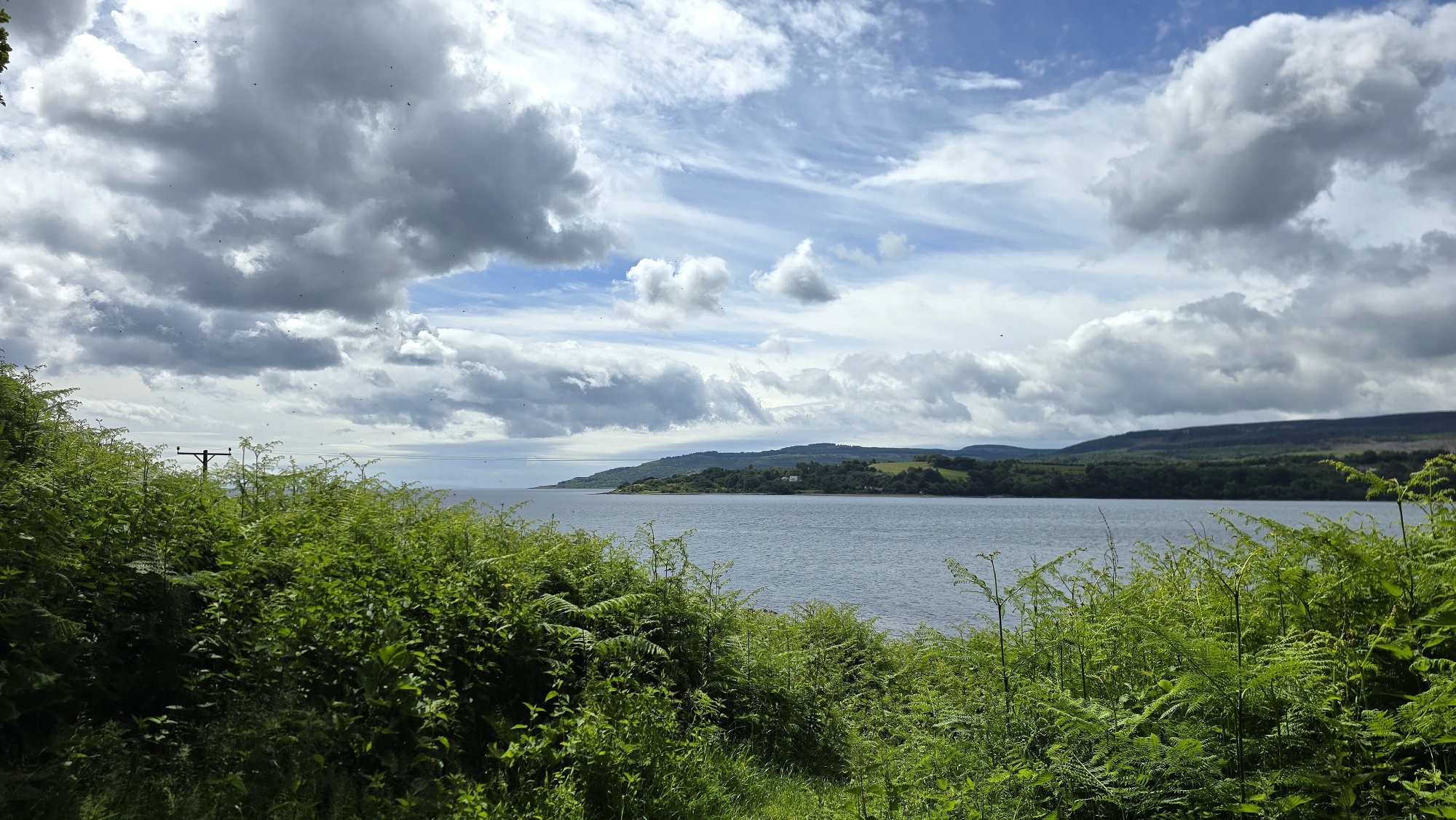
Saint Molaise’s Cave would have looked different, and it is thought that the drystone wall of the cave would have been taller for shelter at around ten feet high.
What kind of flora would be growing on Holy Isle? Was the sea levels higher and closer to the cave? Would the shape of the landscape and flora on the Isle of Arran look different?
Healing spring
Not far from the cave we found the Healing Spring, also known as a Healing Well. I could see the water rising and flowing from somewhere underneath the foliage. In times past the water was thought to cure illnesses and bring blessings. It’s overgrown now and doesn’t meet the EU standards for drinking water, so I didn’t drink it.
Healing spring video clip
The video clip below shows you the flow of the water
Instead, I splashed the water on my right wrist where a dry skin patch had been bothering me for a few months and not going away. Now this surprised me, as by the time I returned home it had completely gone! I couldn’t believe it. I felt quite strange but also excited about possibly why it had healed.
Sadly, within a week or so of being back home the dry patch came back, and I still have it. I was a little upset as I believed there was healing in the spring water. You never know, maybe there was, and it only lasted while I was on Holy Isle and the Isle of Arran, the healing magic of nature.
Possibly being on holiday and away from the usual stress helped it disappear. Or another scenario I thought of is I wasn’t using a computer mouse for a week, hence no contact rubbing of my right wrist where the dry patch is. I use my computer often with my full-time job and personal hobbies.
Tibetan Buddhist rock paintings
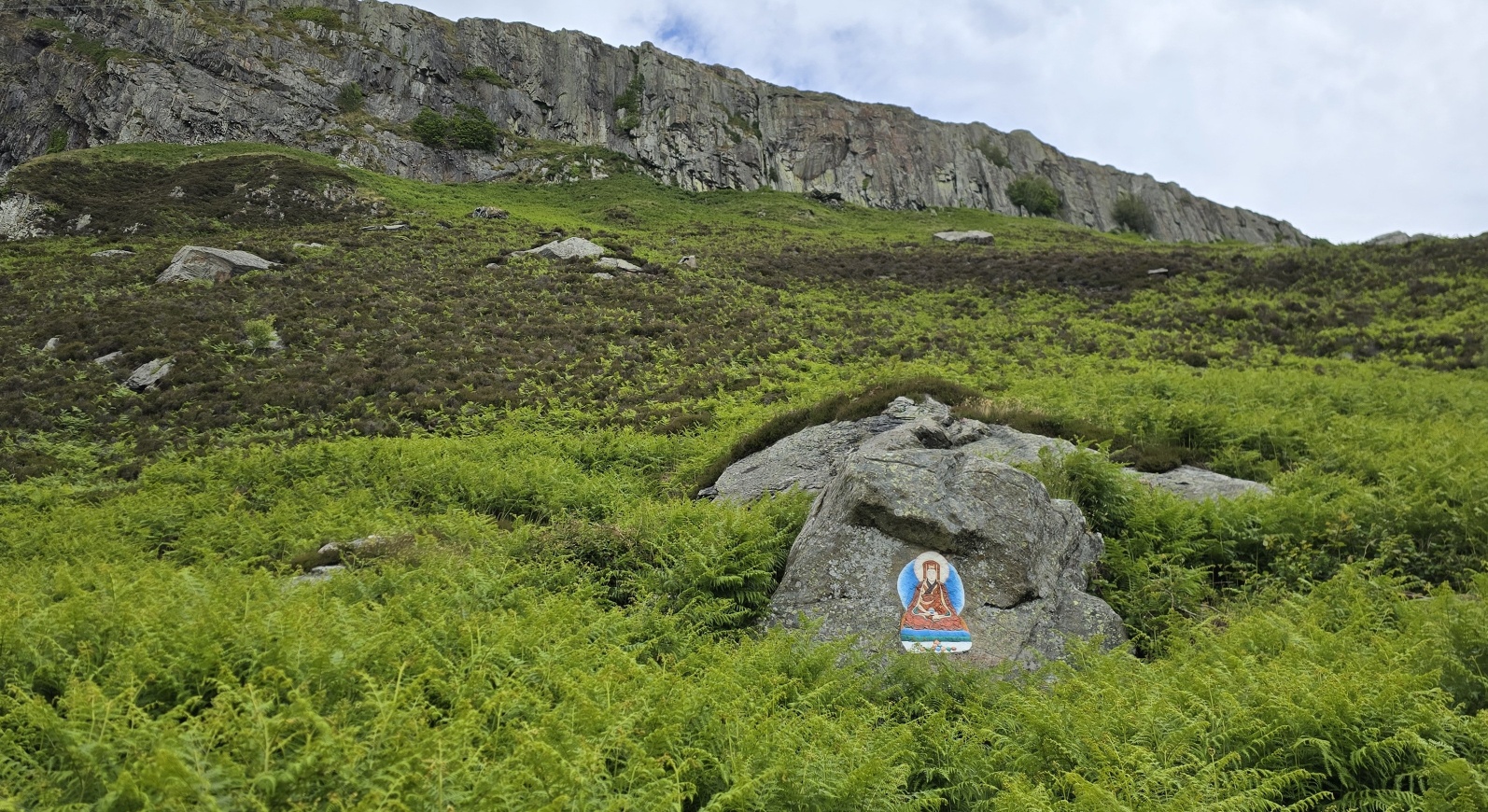
The next points of interest were Tibetan Buddhist rock paintings that appeared on rock faces. The carvings are slightly raised out of the rocks rather than engraved into them.
The rocks were originally carved by Gyamtso Tashi, Tibetan master carver from Samye Ling. Dechi Wangmo (unknown-2003), painted the carvings. She was a painter and former caretaker of Holy Isle who trained under Sherab Palden Beru (1911-2012) the master Thangka painter. Over the years other painters have repainted the rocks to keep them maintained and vibrant for us to admire.
As I was admiring the rock paintings on this calm, peaceful island, I was also interested in finding out a little more about them and their meanings. The colours on the carvings are so vivid and beautifully painted.
The rock painting below is ‘White Tara’.
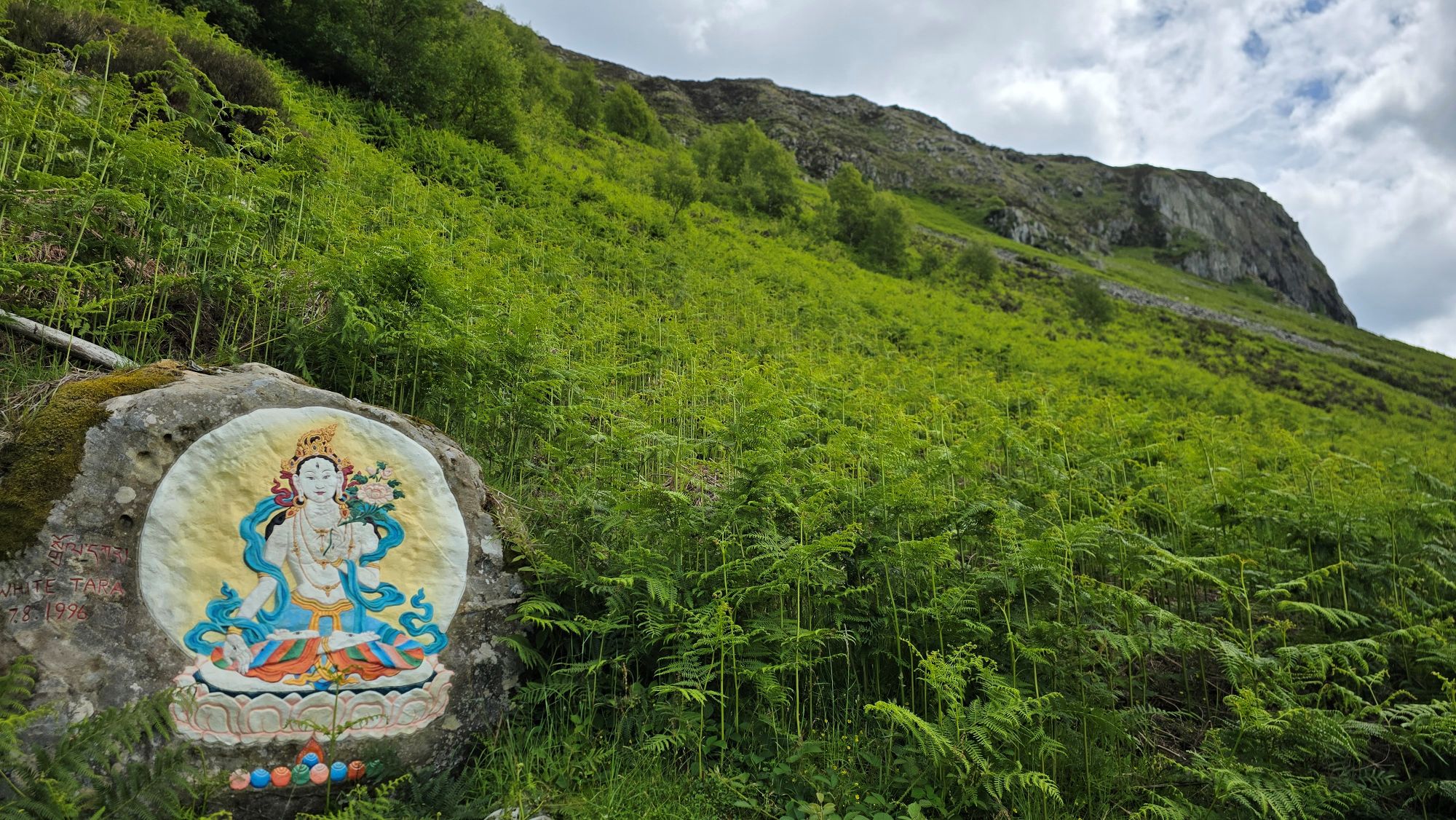
Tibetans pray to ‘White Tara’ for health, healing and longevity. She offers healing to our wounds, whether it is our bodies or our minds that have been hurt.
The rock painting below is ‘Green Tara’.

Green Tara is a Buddha of action who helps us overcome fear by removing obstacles on our path. She is quick and fearless, ready to spring into action when she is needed.
Tibetans think of ‘Tara’ as having 21 manifestations, taking a different colour and offering a different energy or virtue to help us on our spiritual paths. Green Tara and White Tara are the two most popular. ‘Tara’ is also known as the mother of all the Buddhas, because of her compassion to every being and her great wisdom.
Apologies in advance if I have any of the Buddha information wrong as I am not an expert in this field. There’s a wealth of information online to understand and I can see there is a lifetime of learning in Buddhism!
I’ll add a link to ‘Buddhism on Holy Isle’ below if you’re interested in reading detailed information about the rock paintings. I also think I missed taking photos of all the paintings we passed.
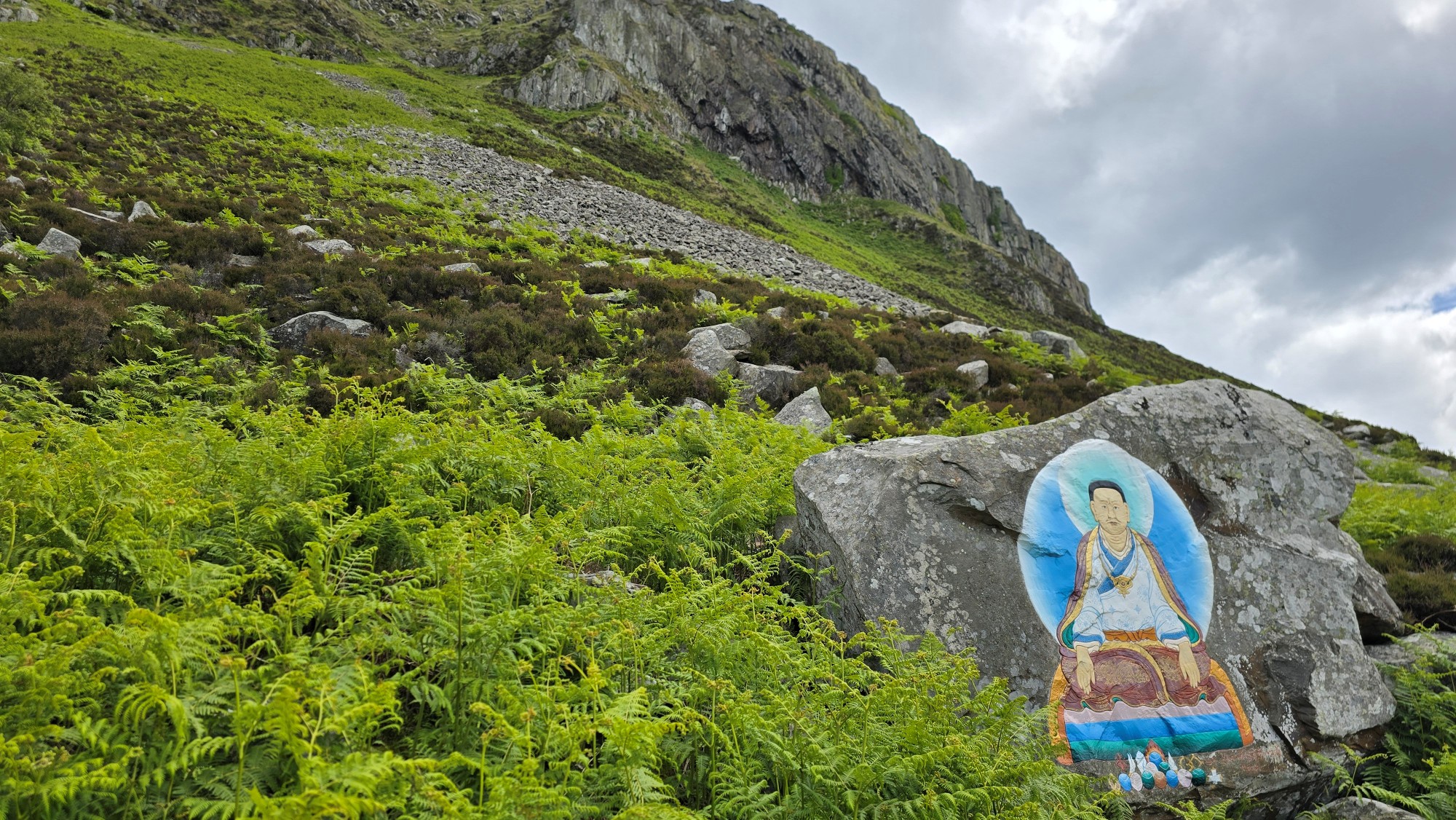
What a beautiful place to sit and paint, as long as it’s a ‘Midge’ free dry day! Painting can be very therapeutic, another hobby I would love to try sometime.
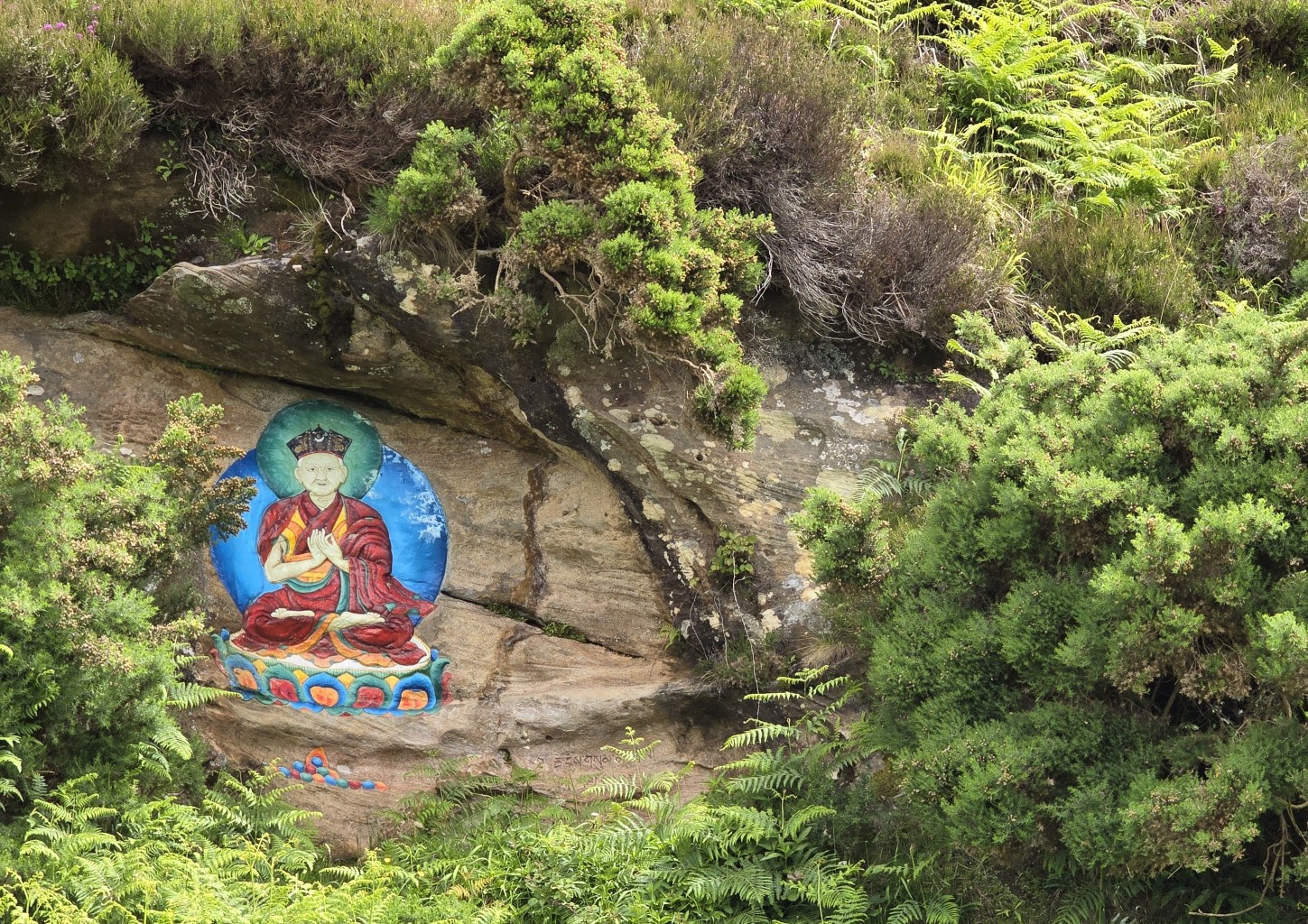
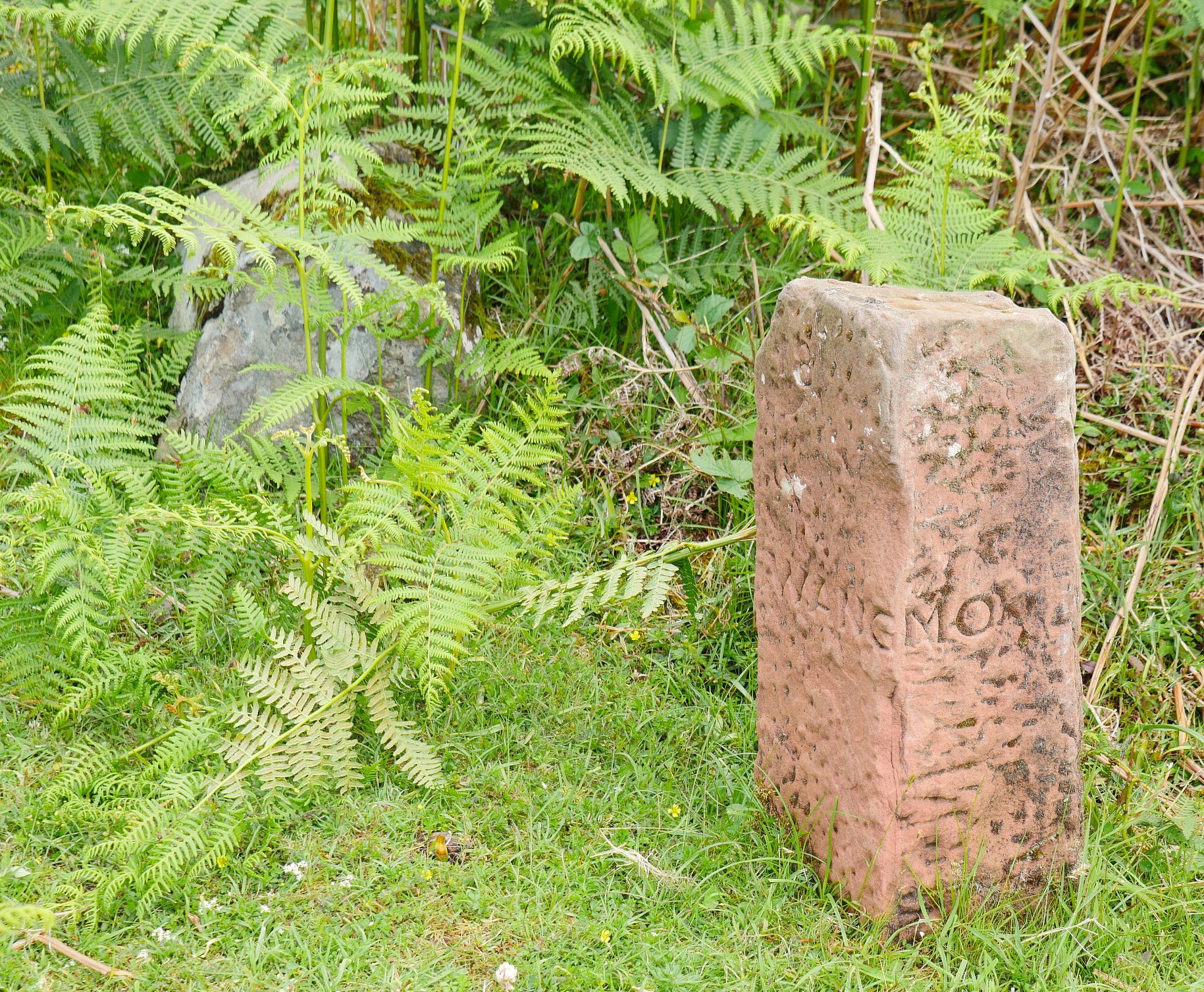
The Arran Arts Heritage Trail has also listed Dechi Wangmo as a featured artist for their arts heritage trail. This isn’t best photo below, but you can see ‘WANG’ on the left side with stone number ’18’ above it, and ‘MO’ on the front.
Boulder hopping goats and rock resting sheep
I was excited when we were welcomed by more Saanen goats. This time a small herd of goats were boulder hopping along the rocky coast. The boulders are huge as you can see!
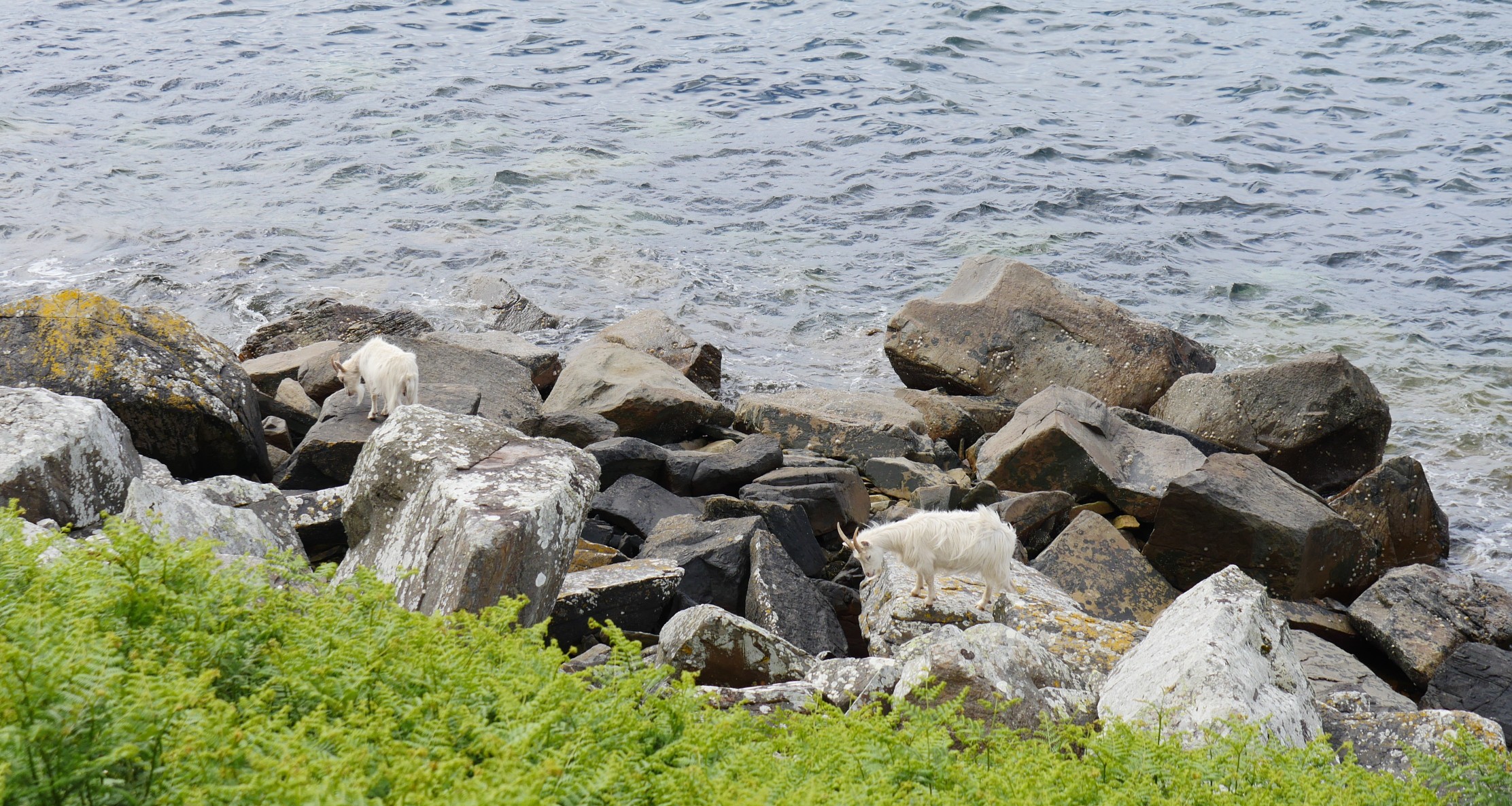
I thought a goat was possibly stuck in between the boulders as another goat was standing above and using its horns to hit it, as if it wanted to jump down and the other goat wouldn’t move on to make space. They are fun characters to watch. You can see this in the video clip below.
Boulder hopping goats video clip
I was worried about them, then remembered their species have been living here independently for 700 years and have managed just fine. Maybe it was just being a stubborn young goat. 😂
They are so good at crossing all those boulders! Just look at this cutie looking up at us.
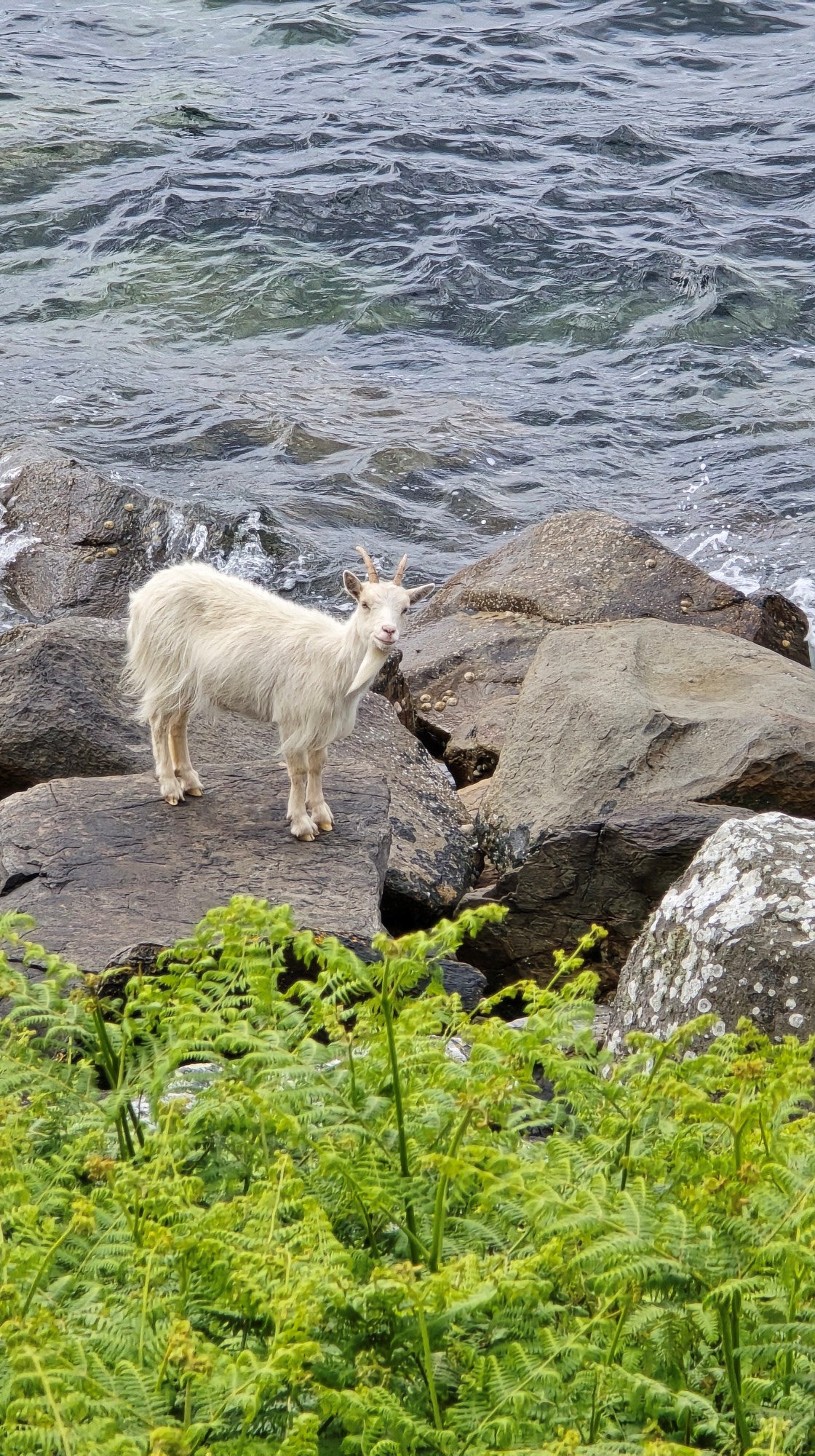
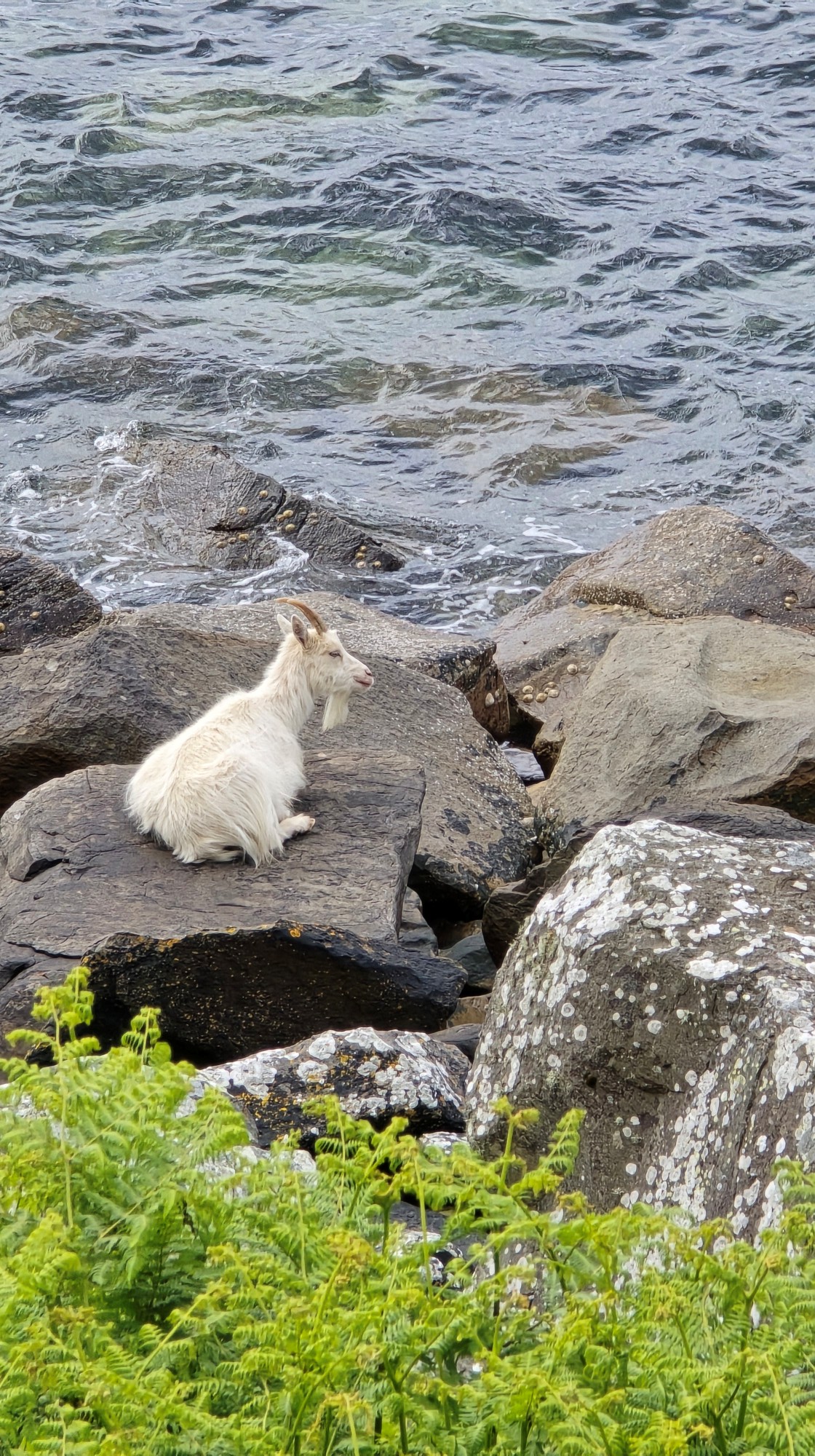
It stood for a while with its hair blowing in the wind, then sat down, looking chilled and enjoying the waves splashing against the boulders.
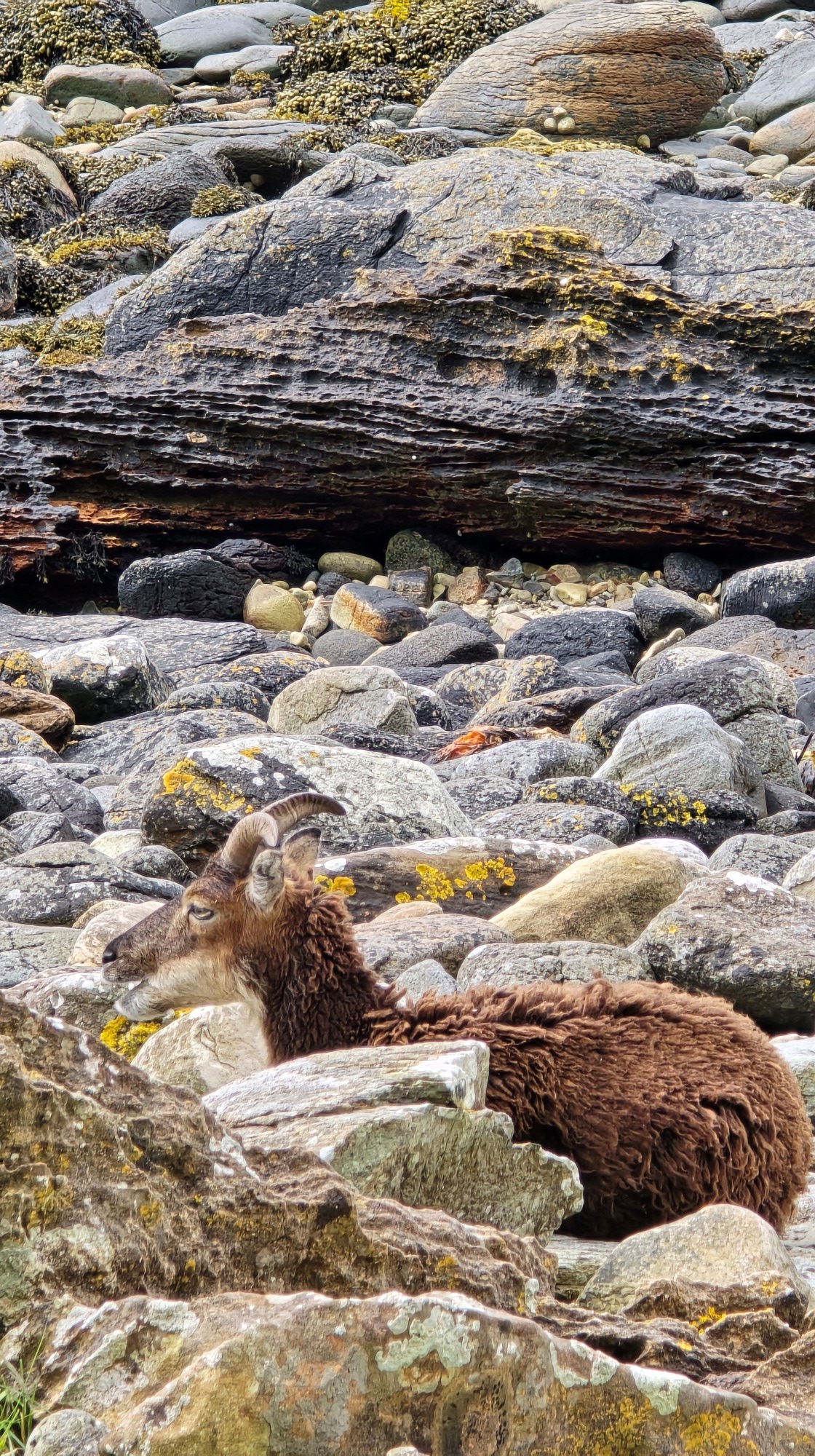
We were being spoiled today as next it was the Soay sheep again. I didn’t notice them at first until Alan pointed them out. This herd were relaxing on the rocky beach, and we could see them munching away on grass and seaweed. They also looked slightly camouflaged from where we were standing, higher up on the coastal path.
Where’s Soay sheep? I think I count four of them?
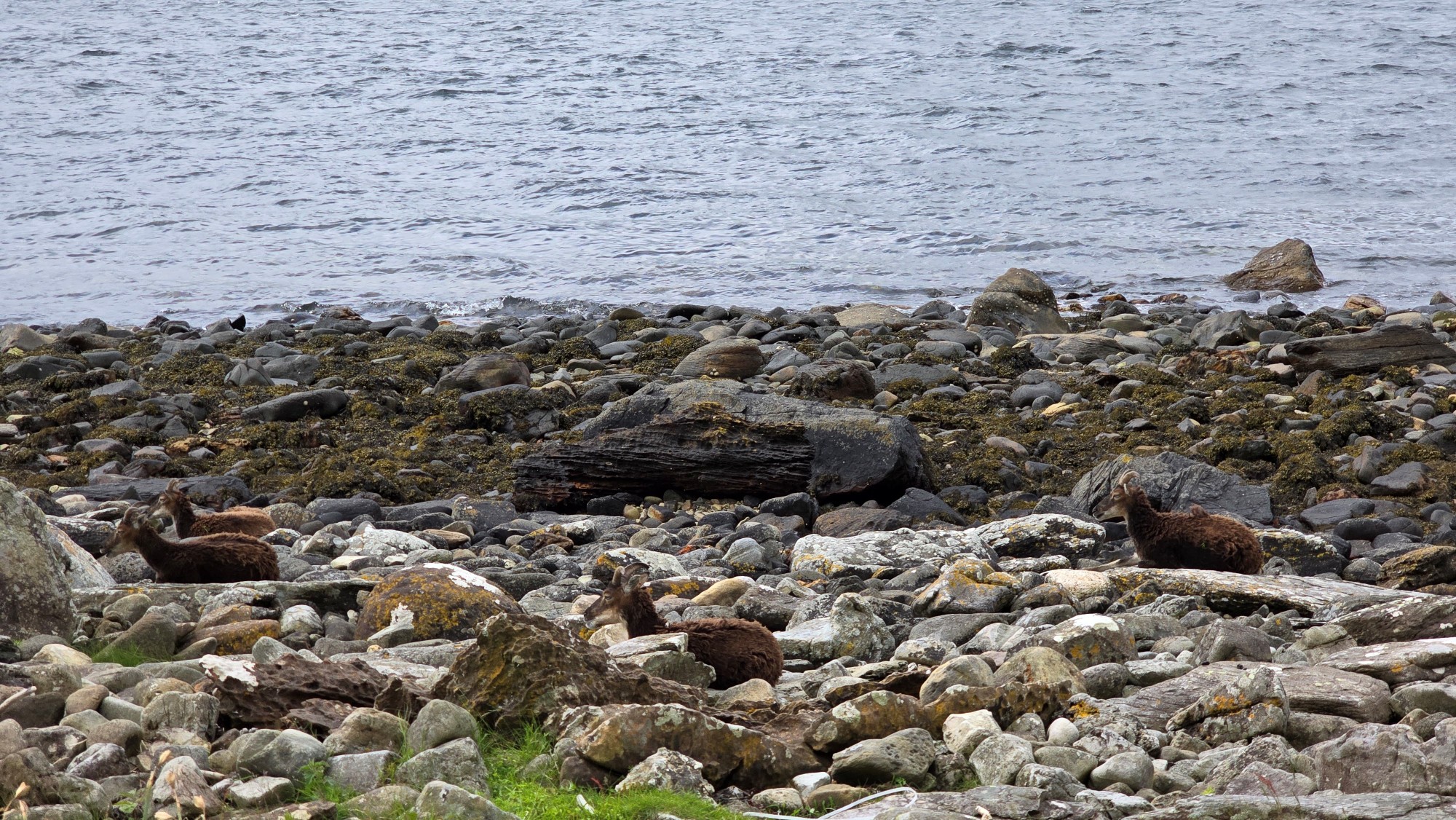
It’s time for a Soay sheep close up. I love their little horns and even the rock formations look interesting!
Mysterious cave
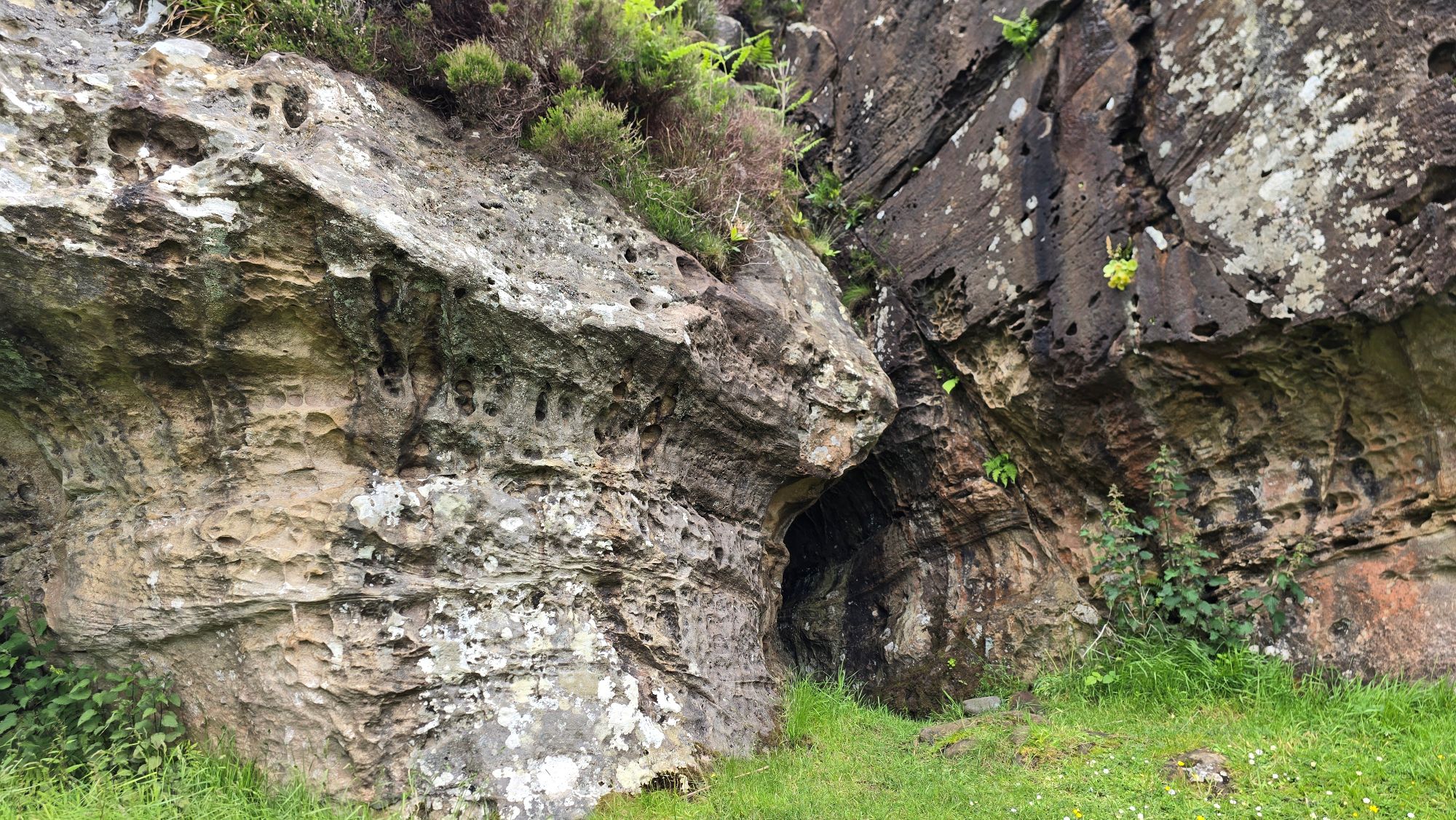
We saw another side path which looked like it might lead to another cave. We were going to skip this as we had dilly-dallied for too long now, but my curiosity got the better of me and I knew I’d regret not looking.
I’m glad we wandered up as a huge sandstone cliff towered above me with what looked like a cave entrance.
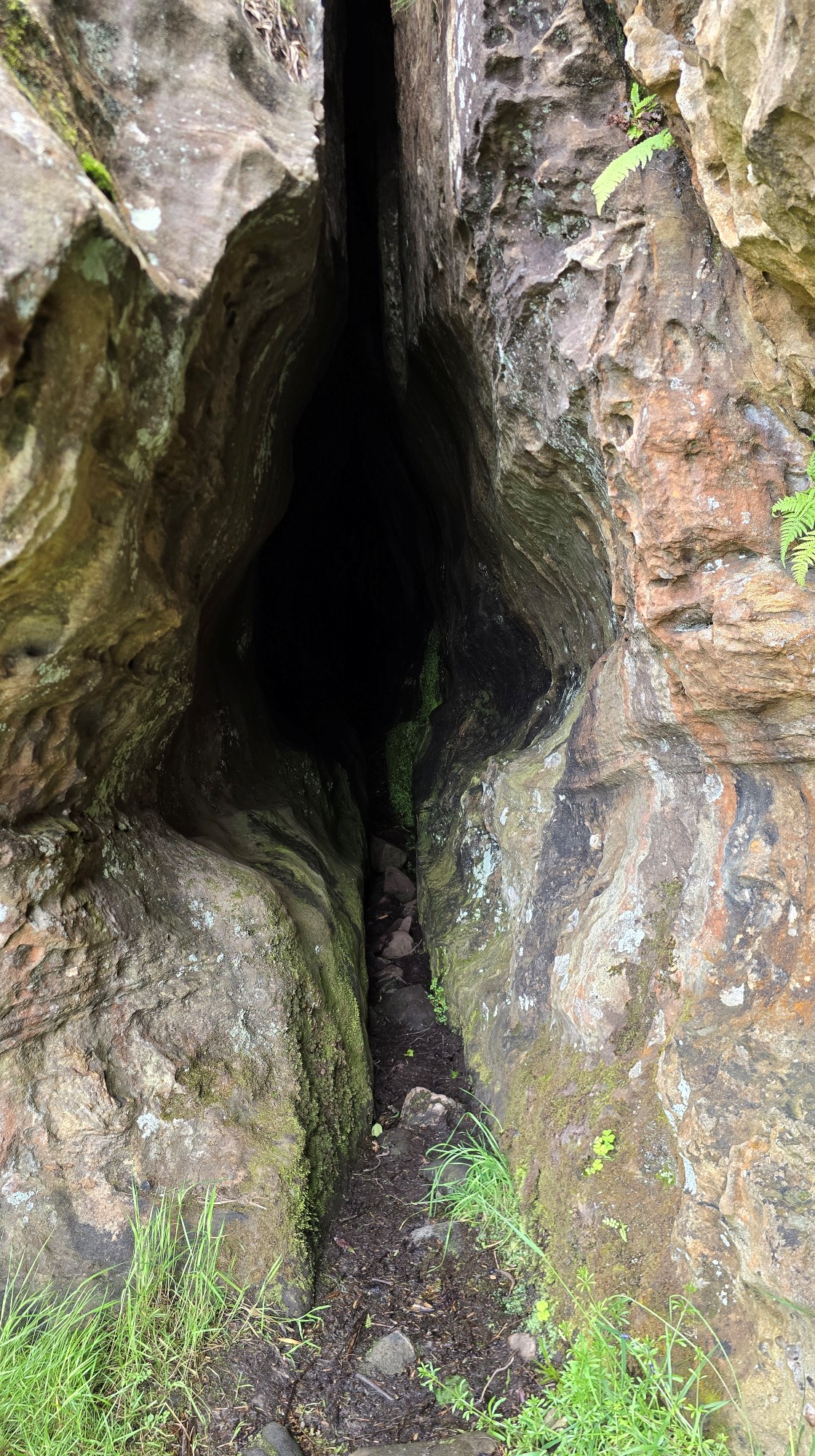
I love cave exploring if it looks safe, but this narrow deep crevasse was dark, slippery and I could hear the trickling of water. I wouldn’t fit through there I thought, and I didn’t have a torch with me to look deeper, so I went no further.
Time was passing and we were still to reach the Pillar Rock Lighthouse, then walk back to the jetty, so we took a few photos and walked back to the safer coastal path. I was still very curious though.
Path to Pillar Rock Lighthouse
We reached the end of the coastline and turned left, heading east up a short hill, and now walking away from the sea.
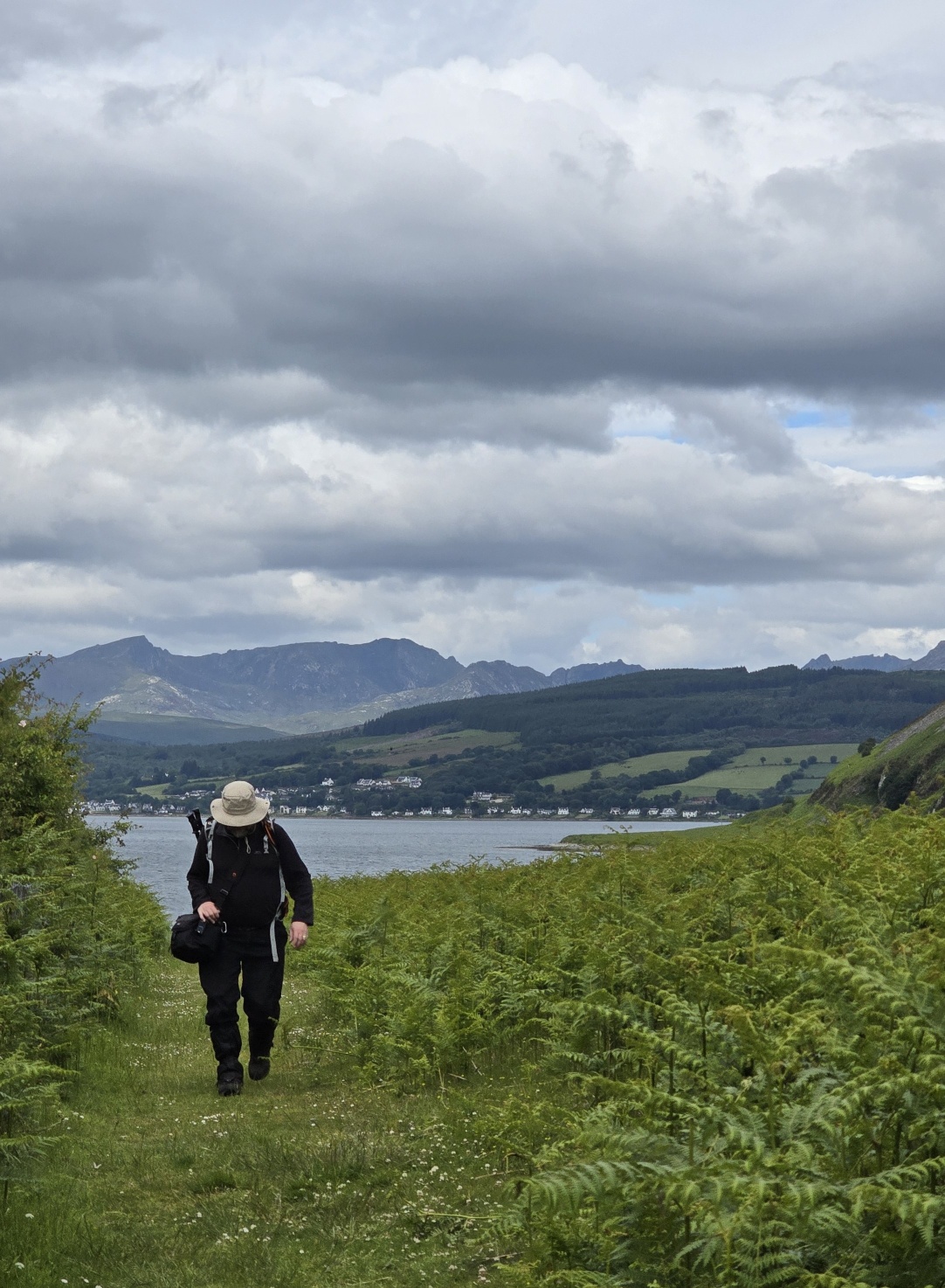
I didn’t know how far it would be to the Pillar Rock Lighthouse, but other visitors who travelled across on the boat were not far in front of us, so we knew we’d be okay for time.
Eriskay ponies
It was wildlife time again and this time the beautiful Eriskay ponies were grazing in a field, along with Soay sheep further back.
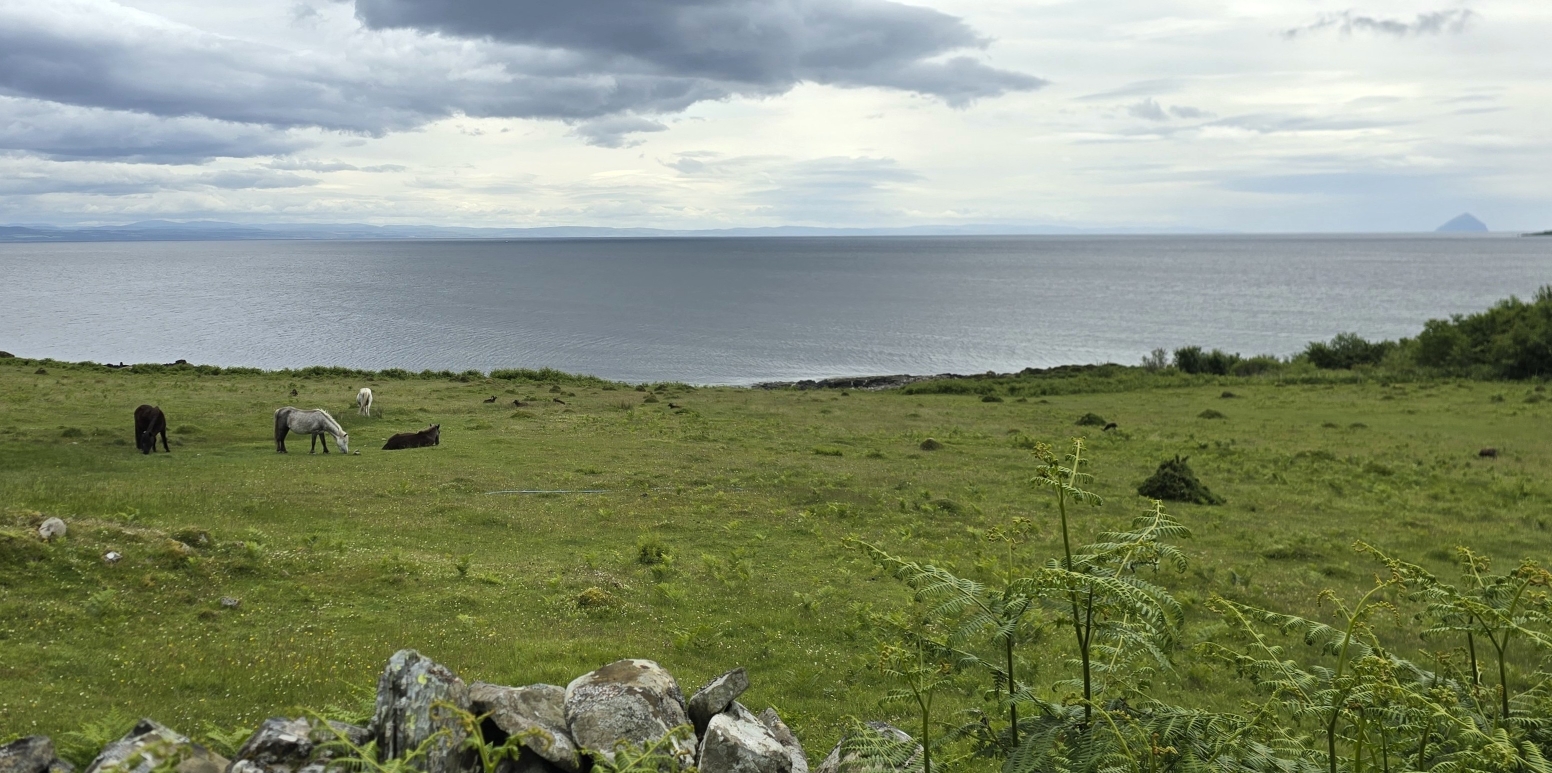
We didn’t get close up of course and stood behind a drystone wall zooming in with our cameras. What a beautiful natural environment for them to graze on.
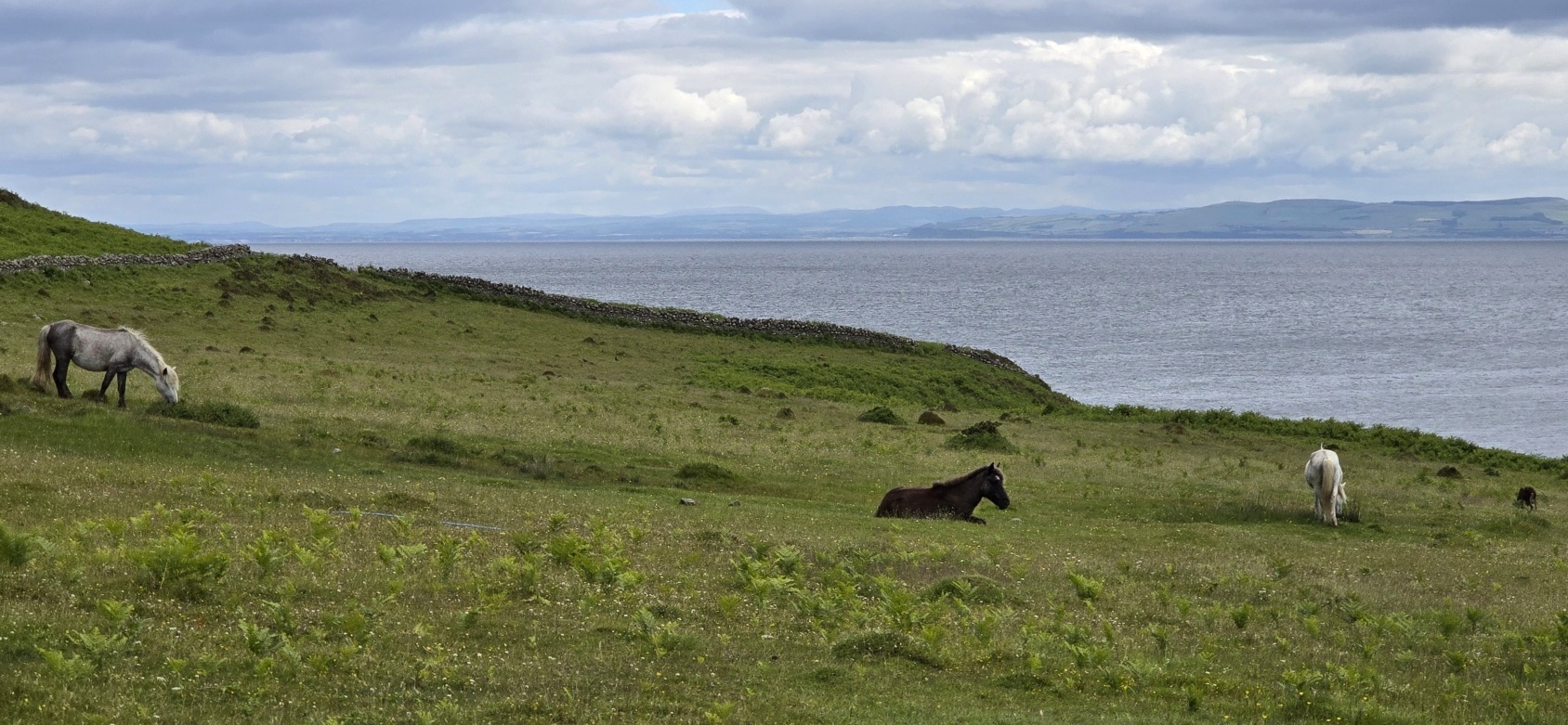
Eriskay ponies were brought to Holy Isle in the 1970s. The breed is among the last surviving of the original native ponies of the Western Isles of Scotland and are classed as a Priority Breed by the Rare Breeds Survival Trust. They have dense waterproof coats and adapt well to living in harsh conditions.

Walking up another hill, I was beginning to feel it in my legs and breathing, but I was okay and pushed on.
We reached a footpath on the left, the way down from hiking Mullach Mòr and taking the full circuit from the jetty. I could see the couple who were hiking to the top in the far distance walking back down the hill. It was good to see them and know they made it safely.
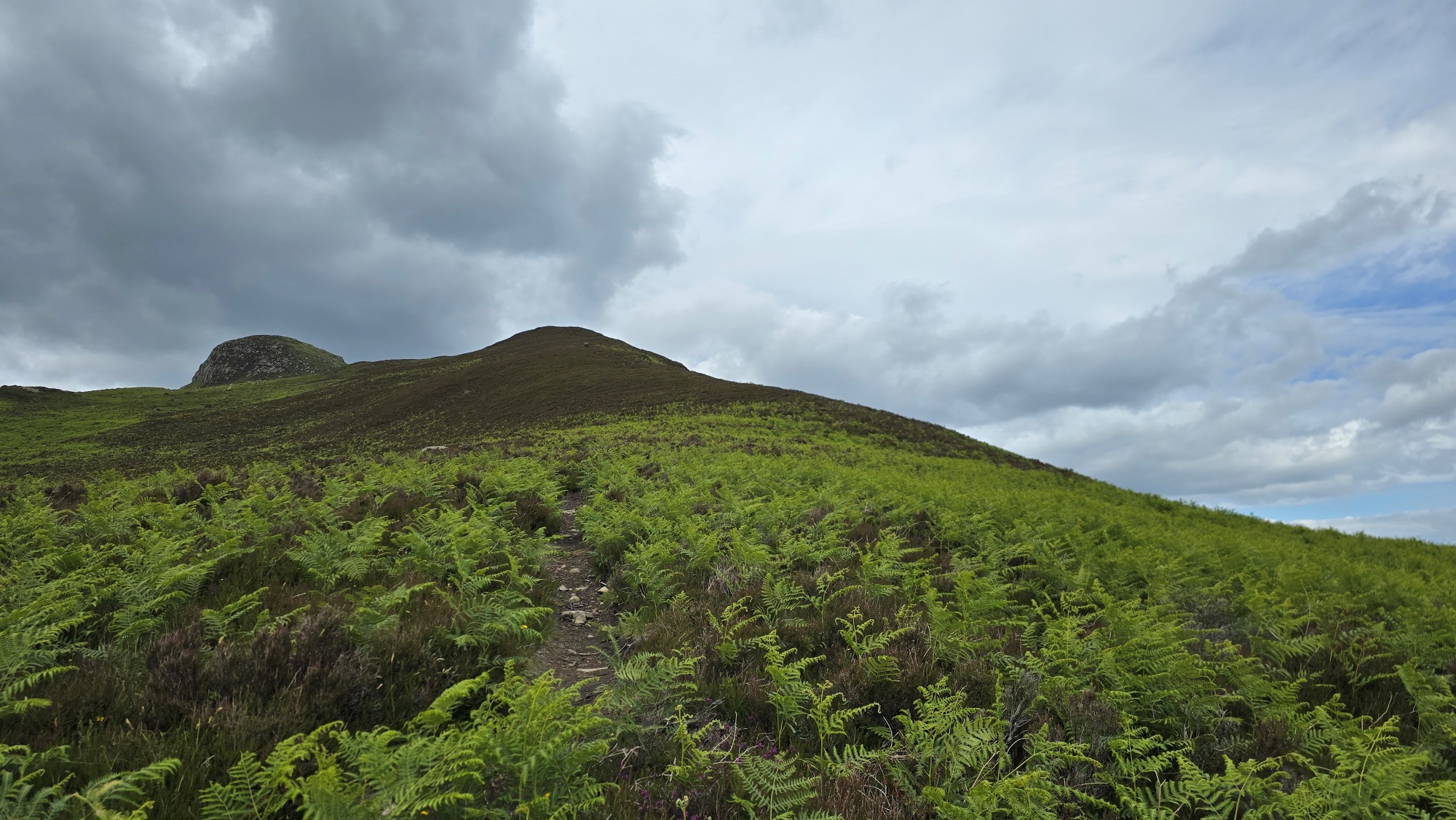
I noticed another narrow path leading to a sea viewpoint, where I looked across at the small bump of an island Ailsa Craig, sitting far away in the distance like a little cupcake. I love looking across the Firth of Clyde to Ailsa Craig and the Isle of Arran from the Ayrshire mainland, and we are also blessed with pretty spectacular sunsets.
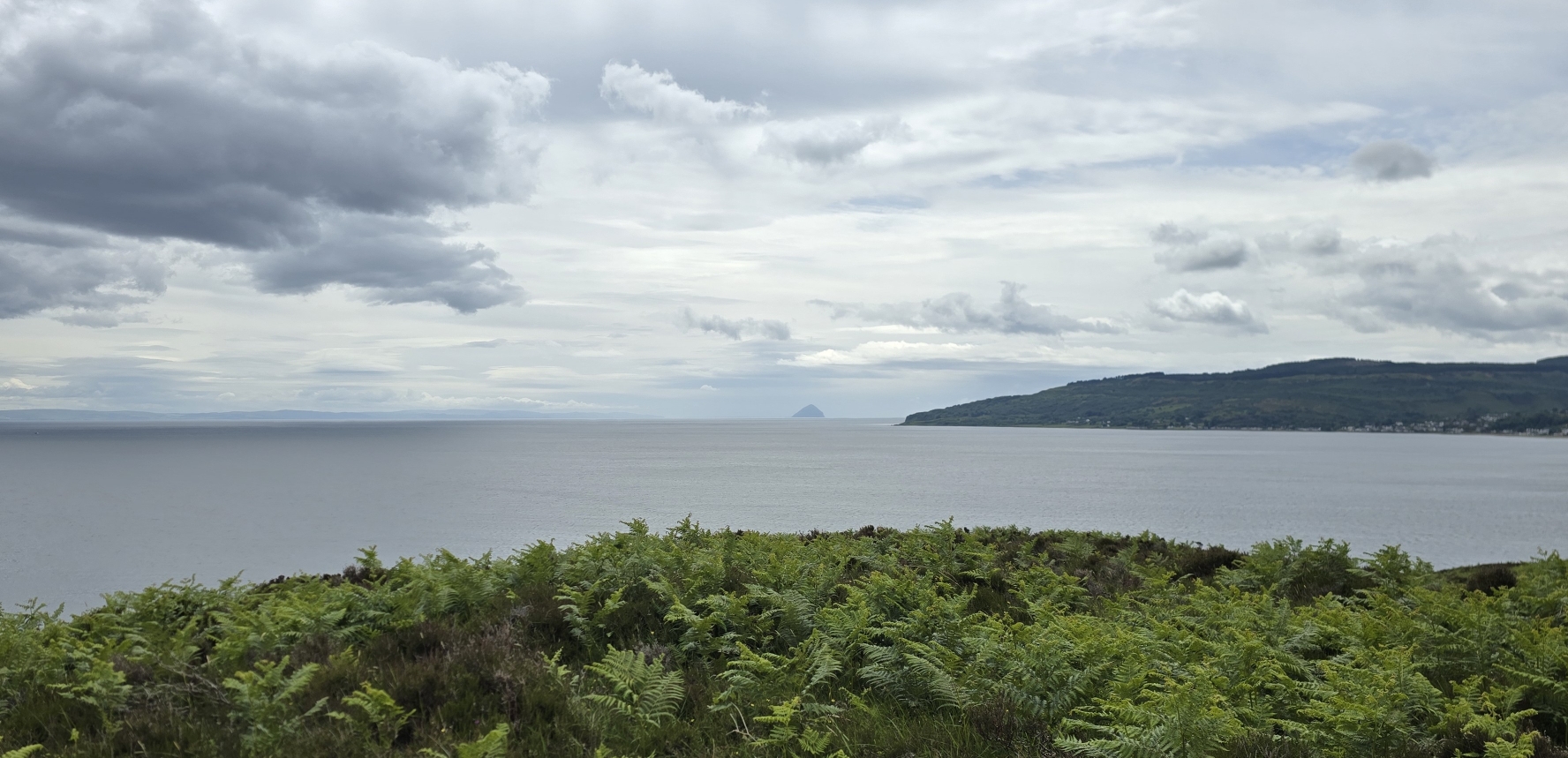
I’ve always wanted to climb to the top of Ailsa Craig, but boat trips have limited time on the island, and I would need longer to reach the top, as always. 😂
The next best thing was the Paddle Steamer Waverley cruise around Ailsa Craig. It was such a great day sailing along the Ayrshire coastline, around the island Ailsa Craig, and seeing over 100,000 Gannets who nest on the island. If you’re interested and missed that blog story and video, I’ll link it below.
Pillar Rock Outer Lighthouse
Yay, I could now see the Pillar Rock Lighthouse perched on the edge of the south east point, with a downhill trek to reach it.
All I could think about at the time was if I walk down there my legs will need to carry me back up again. 😂 Should I go down? Do we have time? It was a must visit though to see the Lighthouse close up.
Pillar Rock Lighthouse is the Outer Lighthouse, one of two Lighthouses on Holy Isle, with the Inner Lighthouse we passed earlier being a private retreat. You’ll notice it’s not the usual round Lighthouses we see across Scotland.

This was the Northern Lighthouse Board’s first square Lighthouse. It was built in 1905 by lighthouse engineers David and Charles Stevenson, descendants from a long-line of ‘Stevensons’ who were Lighthouse designers and builders for over one hundred and fifty years.
There is no public access but even just standing beside the Lighthouse, looking across to the mainland and a faint peek of the northern hills was wonderful. I’ve always wanted to stay in a Lighthouse for a night or two. It might be kind of spooky though, especially on a stormy night.
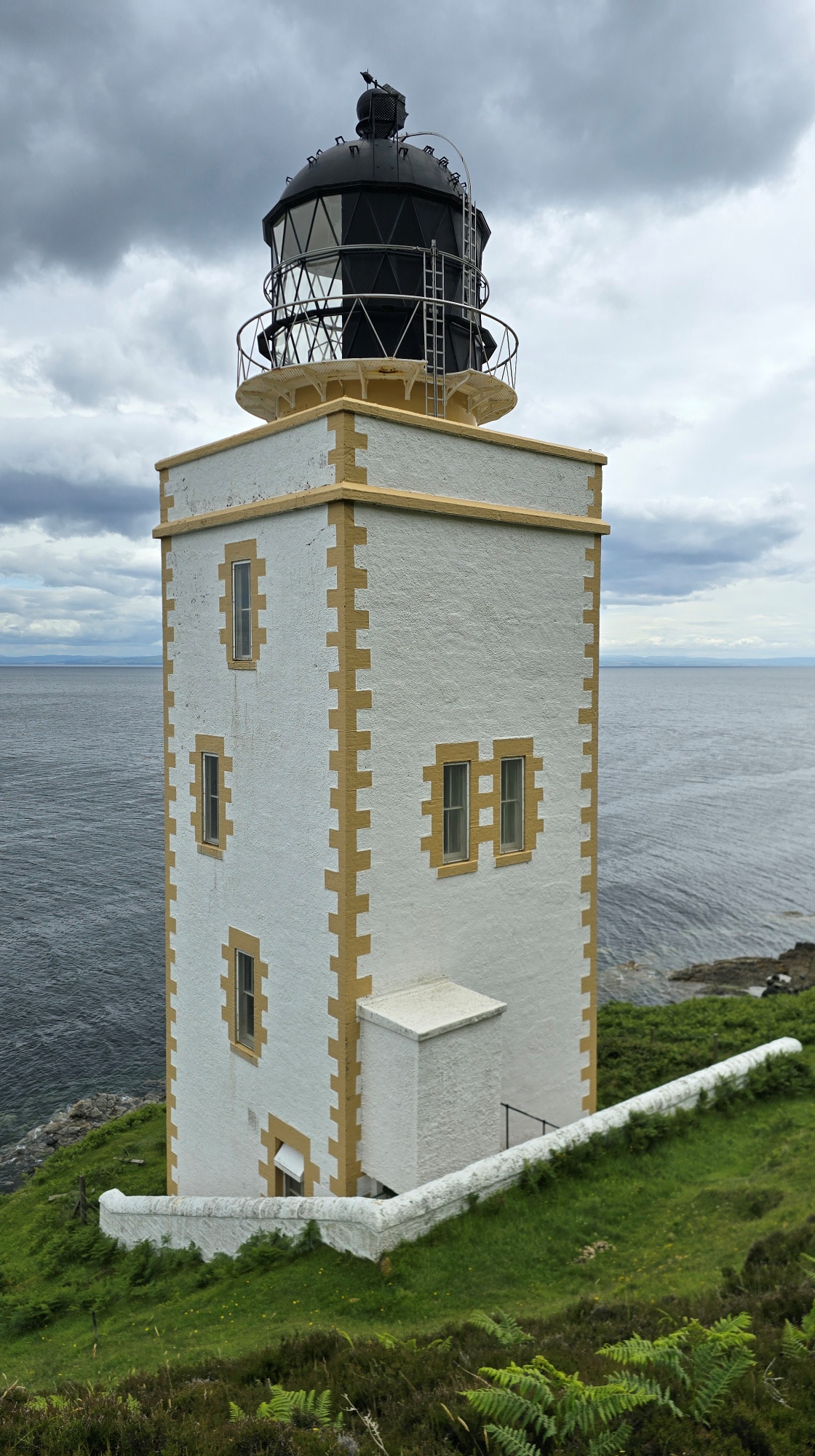
Again, you know me, yes, I would have loved to stay here longer, the story of my life at the moment. 😂
We felt a bit rushed as we knew we had to get back in time, so we only stopped for about five or ten minutes at most, then back up the hill the way we came.
Back again to the jetty
We didn’t stop as much on the way back as we had already seen all the lovely sights, so at least our pace was quicker. The wooden houses on the hillside are so intriguing and look like little hobbit homes. These are private retreats and not be approached, so I only admired them from a distance.
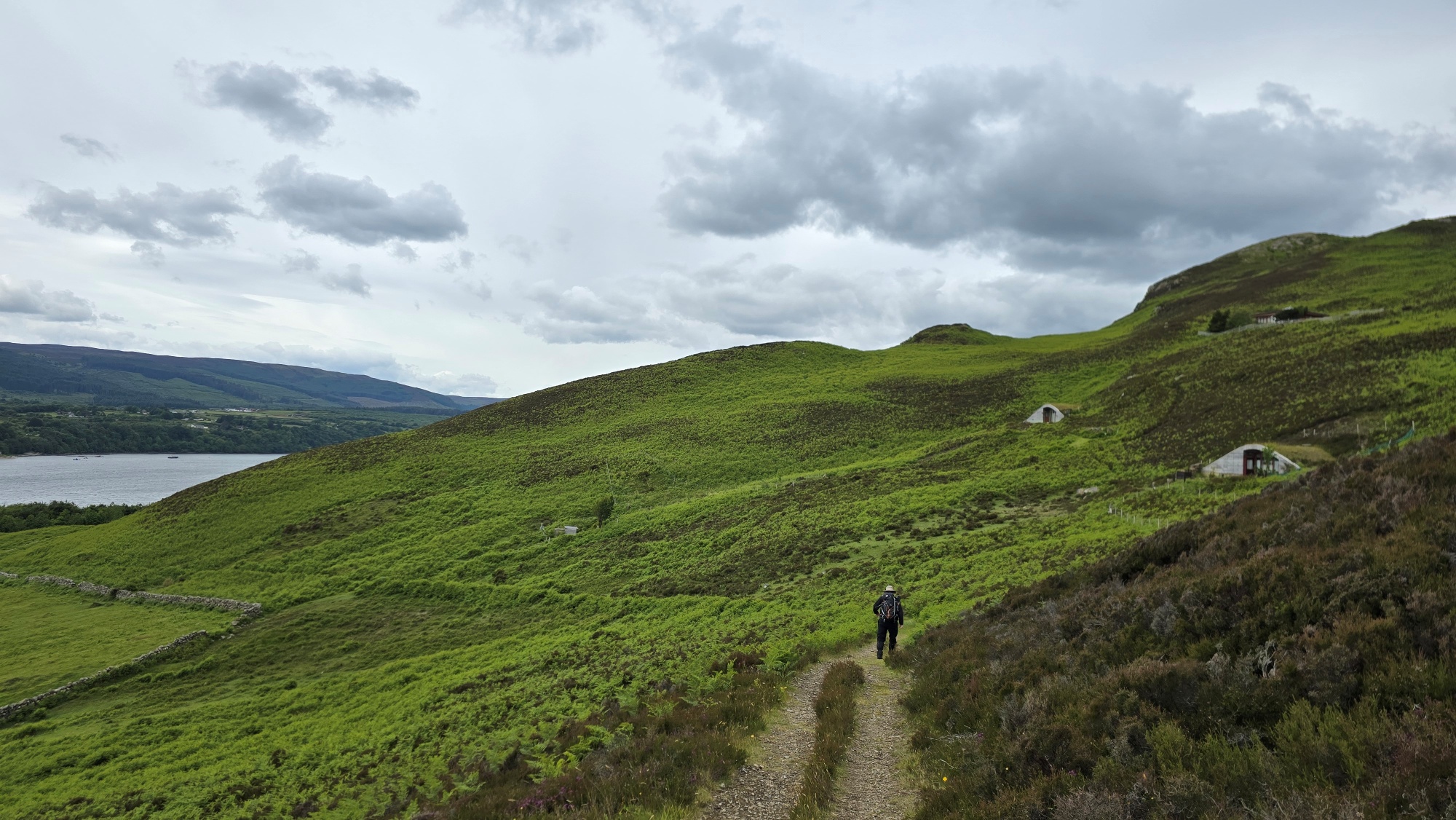
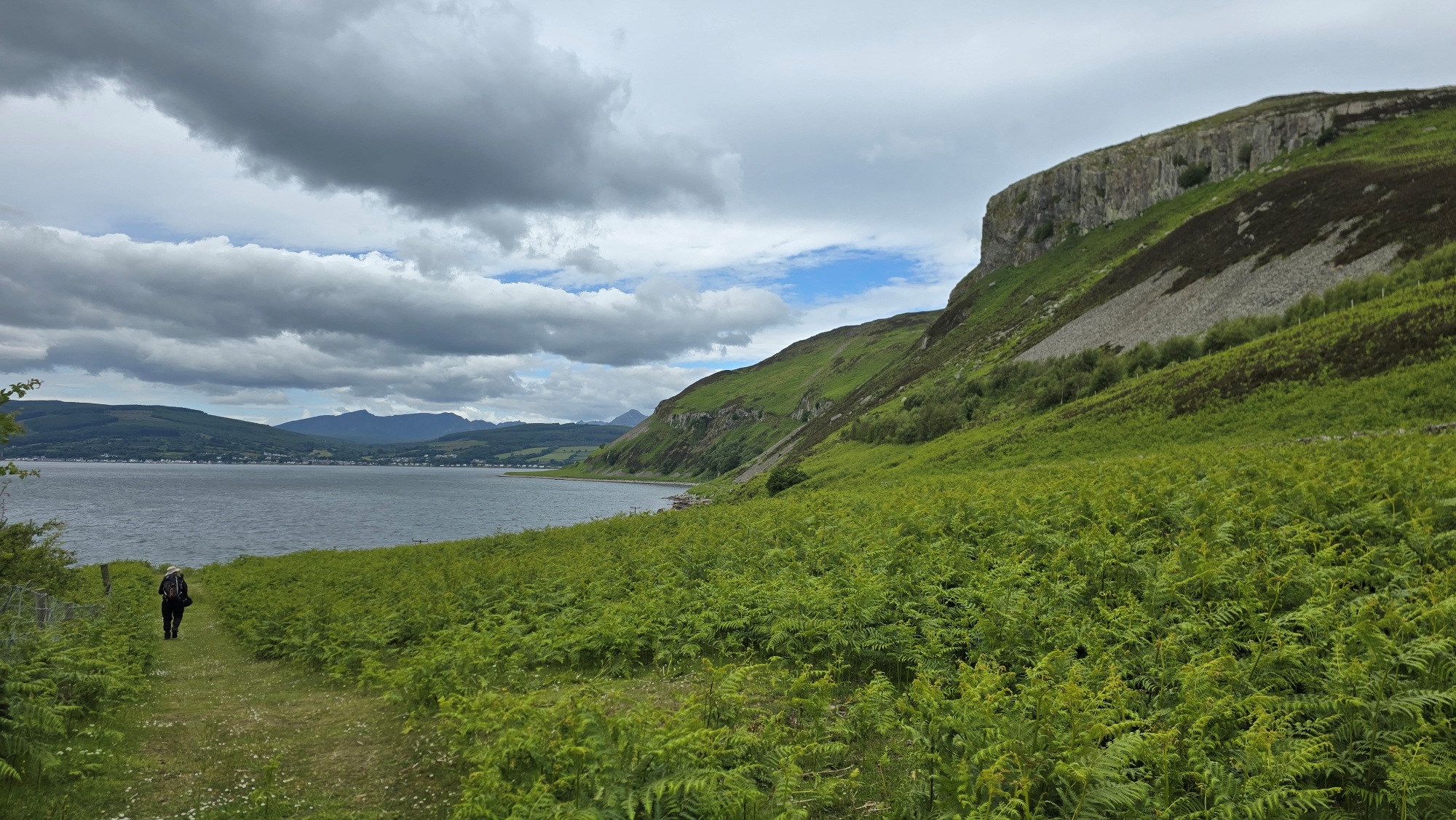
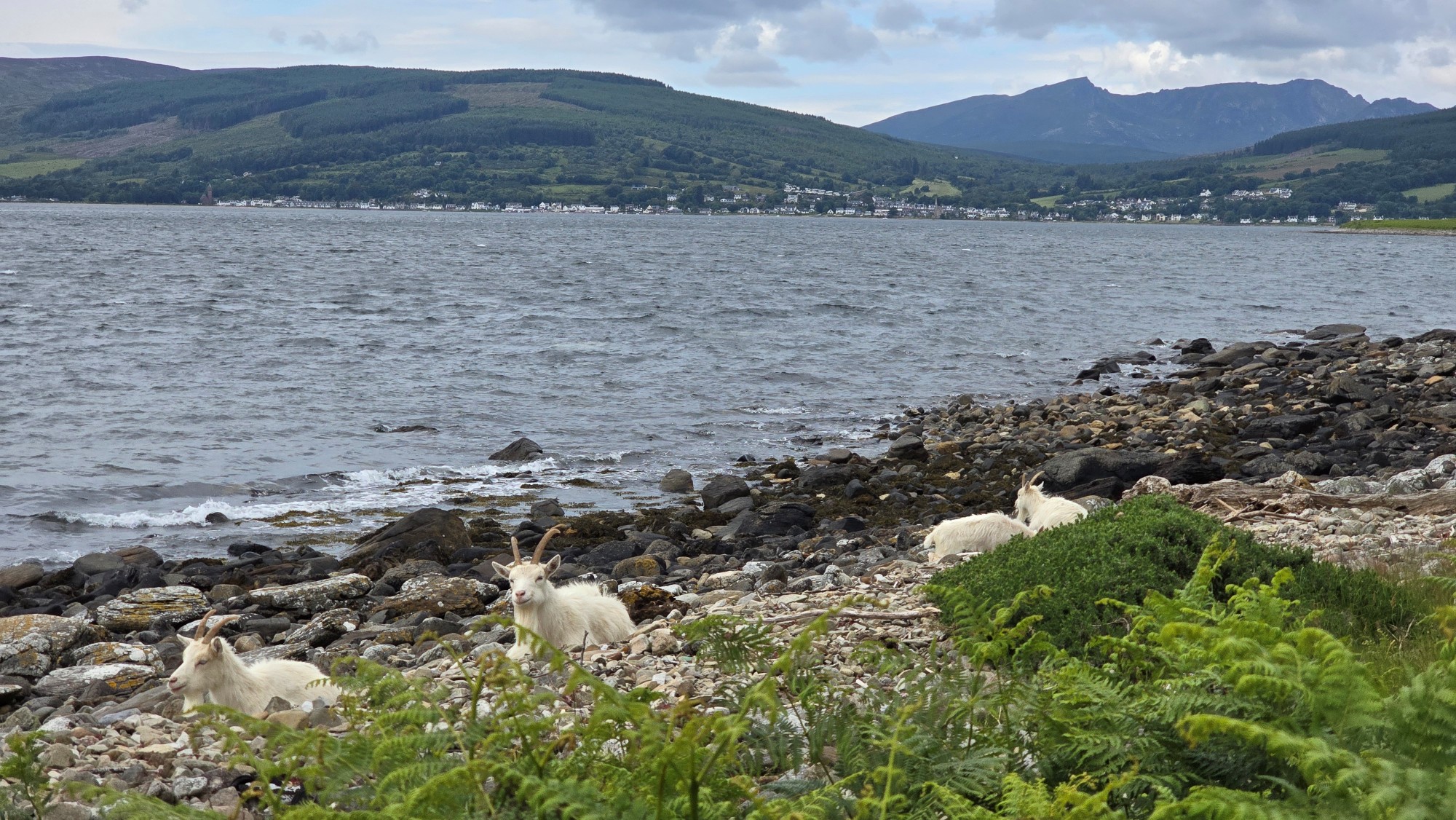
On the way back, the Saanen goats were now chilling on the rocky beach as the boulder hopping earlier had tired them out.
The lady who was visiting her friend on the island was walking towards us and looking for St Molaise’s Cave before it was time to leave. As she ventured up to the cave, I offered to wait for her and walk back with us, which she seemed happy to do.
This is when I was overthinking again. Did she prefer alone time or company walking back? I’m glad I checked with her though.
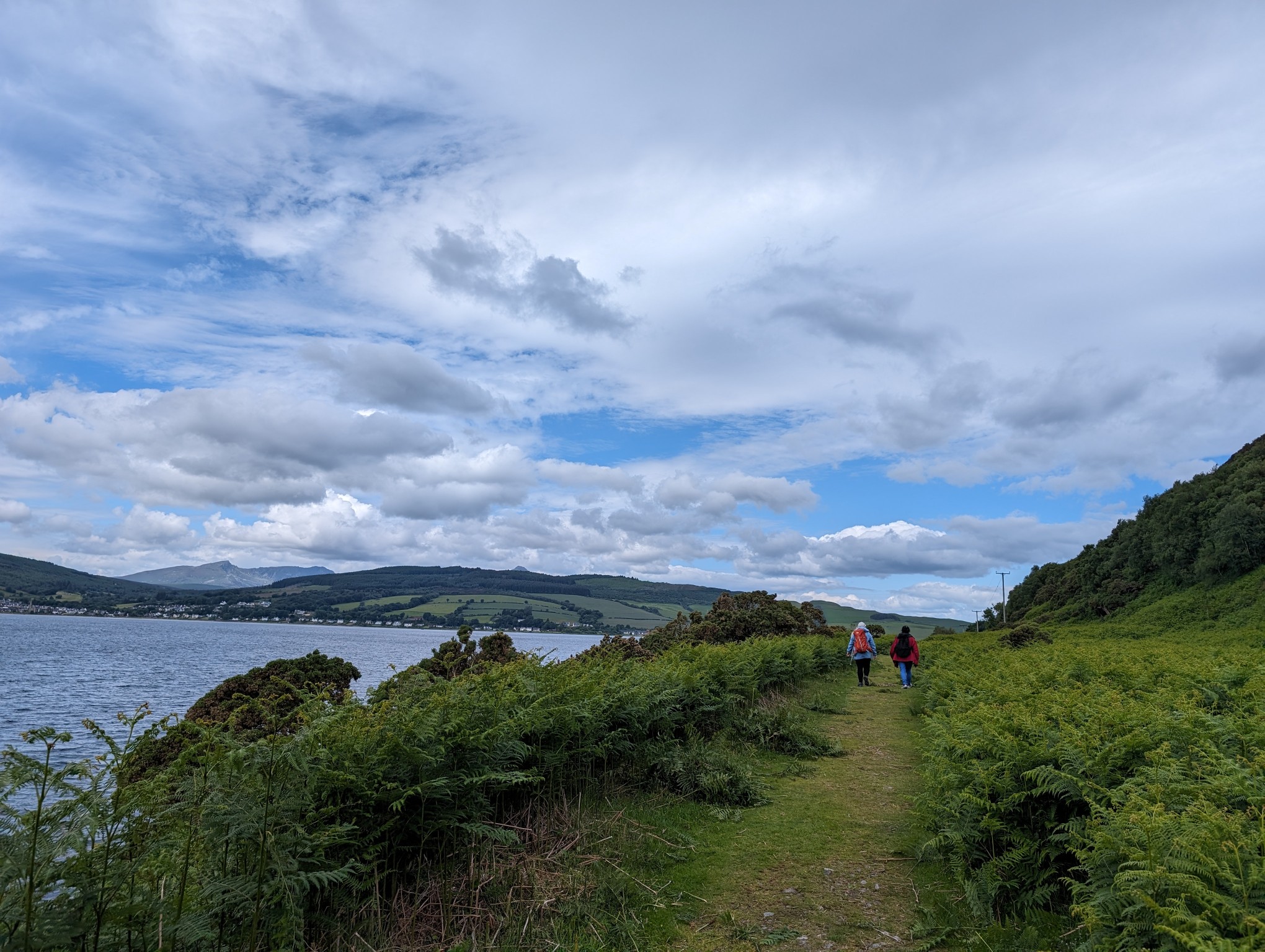
As we walked back to the jetty, she was telling me how she enjoyed running, so it was nice to chat about our experiences as older running women. I don’t run now, but I love hearing other people’s running stories as I can relate and secretly wish I could still run. You never know, maybe I’ll give it a go again one day.
When she said she felt so grateful that she could run at her age, it really hit me and made me realise what a privilege it is to be able to run at any pace, weight or age. I took part in running for six years, starting in my early forties, and I remember feeling disappointed with myself when I was last in my running group, struggling to run faster and improve my running times and distances. I’m not a natural, that’s for sure! In hindsight I should have been happy that I ‘could‘ run and was dedicated to getting outdoors and run every week.
We returned to the jetty with around ten or fifteen minutes to spare and I was relieved we made it back in time. Soay sheep were wandering around near us. Look at this happy family. 🤎
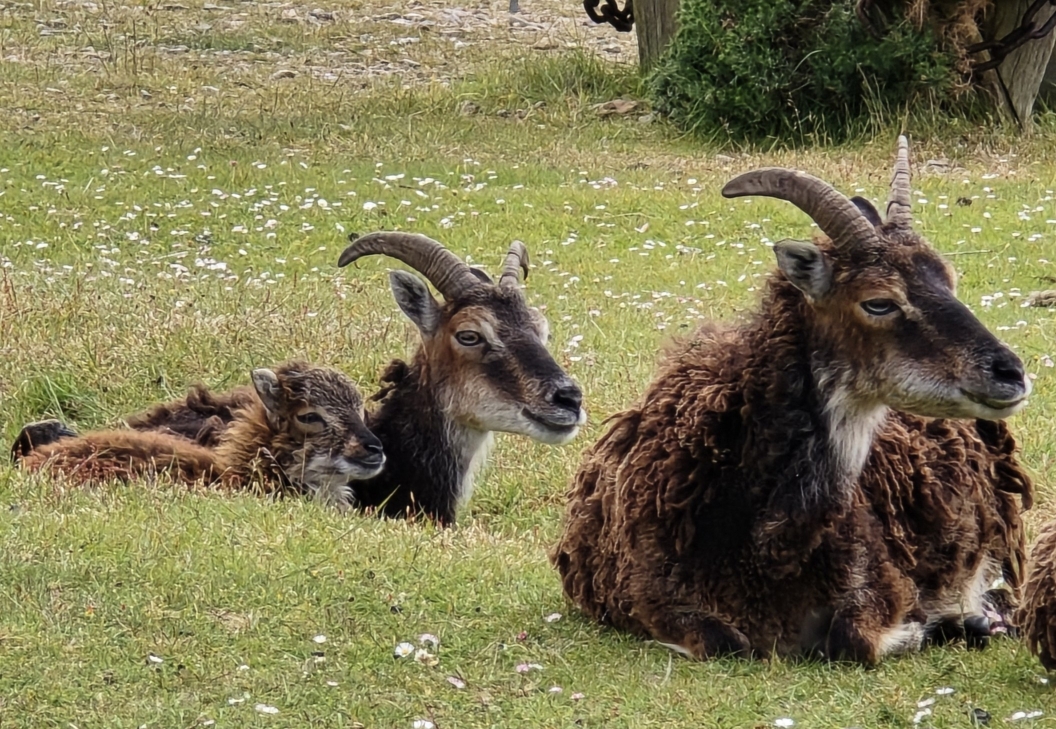
I walked towards the path that takes you to the top of the island as sometimes the animals gather in a field there.
Wow, more Eriskay ponies were grazing in the field and Saanen goats. I walked slowly as far as I thought I could without startling them.
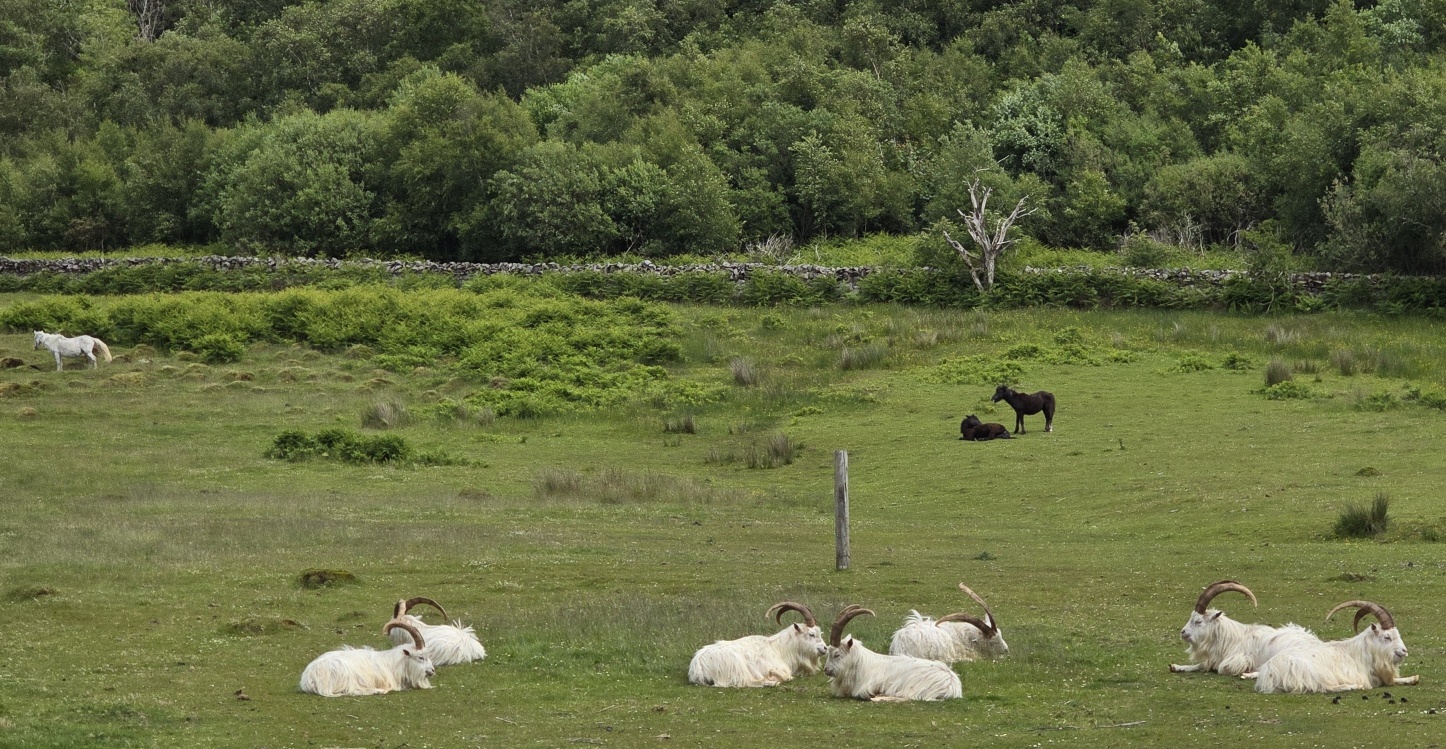
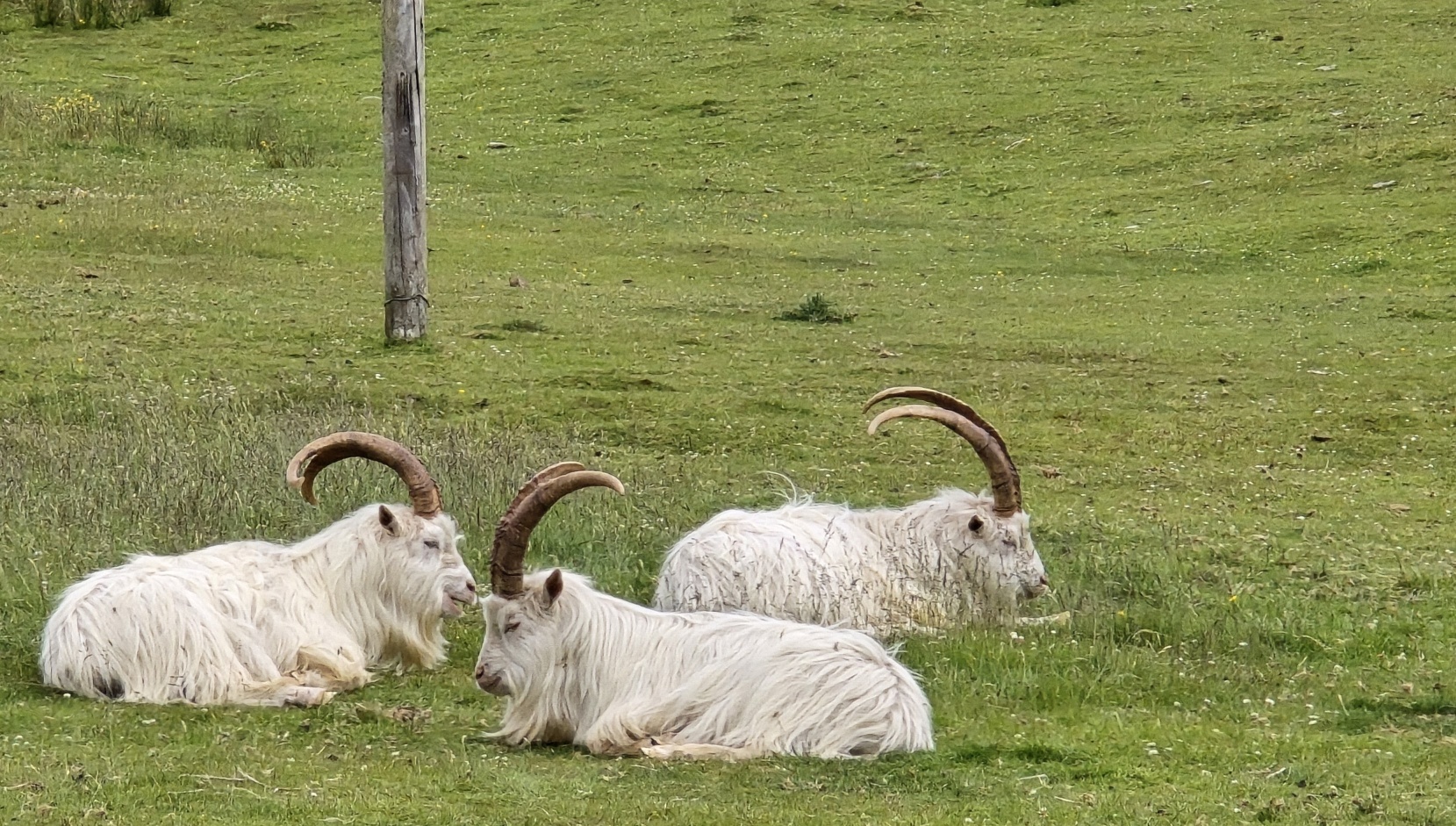
The horns on the Saanen goats were huge, longer than the goats I saw earlier. I wondered if these were the male goats, or just old wise goats.
I watched the brown pony approach the white pony, to nuzzle its neck showing love and affection. What a lovely way to cuddle.
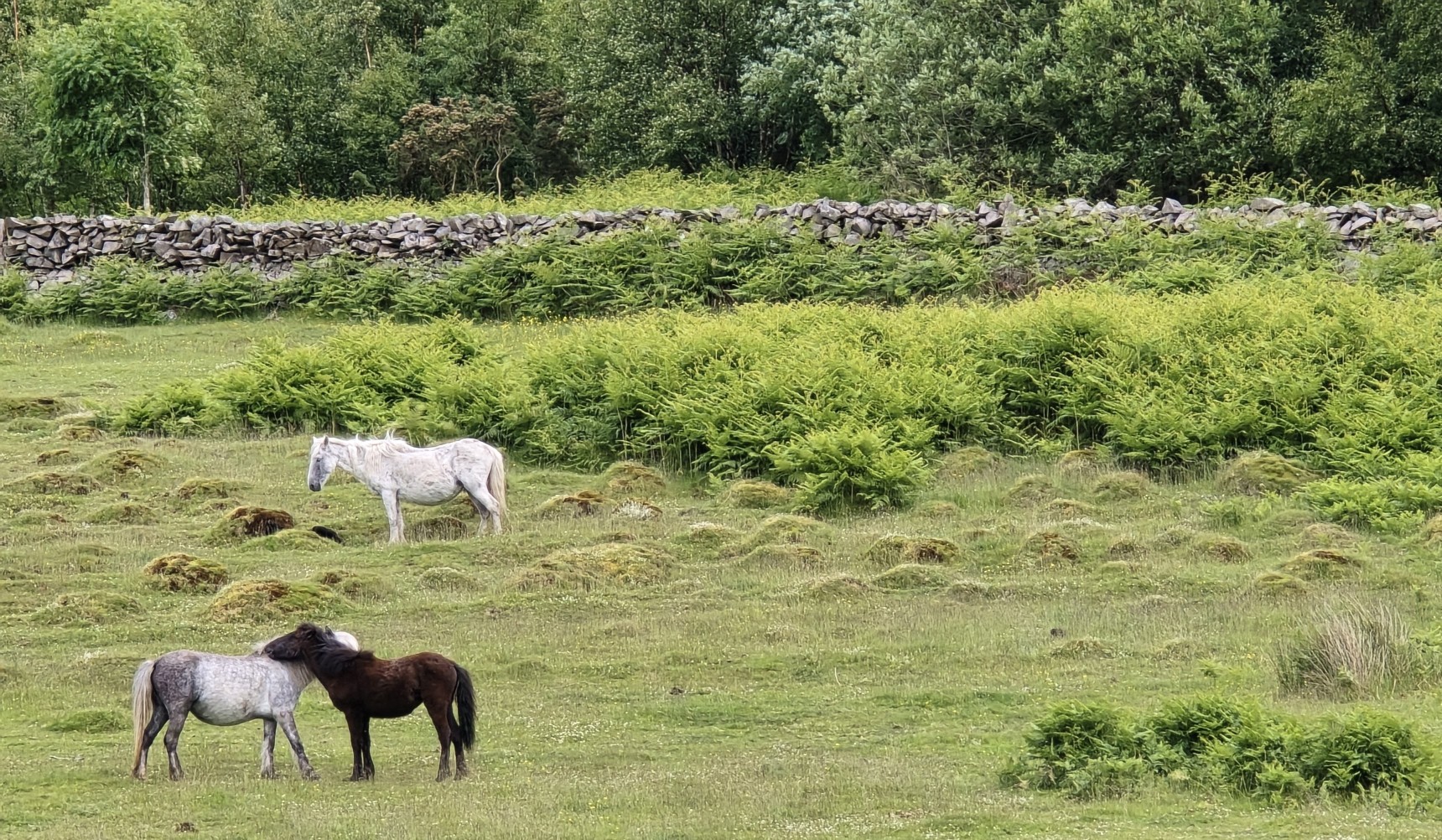
I headed back to the jetty and quietly shouted over to the lady I was chatting to earlier and pointed to where the ponies and goats were grazing. She seemed over the moon she got to see them, this made me happy.
The full coastal walk there and back again for us was:
- Distance: 8km
- Moving time: 2 hours, 20 minutes
- Total time: 3 hours, 20 minutes
When we were on the boat going back to Lamlash, Alan realised he left his GPS sitting on a bench at the jetty. A huge thanks to Lisa, Grant and Izzy for bringing it back on their next sailing. We really appreciated this! 🙏
I’ll definitely go back to Holy Isle again. Wandering slowly along the glorious coastline path felt like a peaceful simple world. I was in my element enjoying a calm place to think and find myself, even if it was just for a short time. I was also happy that I got to see the wildlife this time.
My final 2024 Isle of Arran story will be about our epic Glen Sannox walk and hike. It was an eventful day as always. Gosh, I’ll be returning to the island soon for 2025 and I haven’t even finished writing about 2024 yet! It took me a long time to finalise my River Ayr Way stories, and life takes over my hobbies. 💙
Thanks for reading!
Love, Dawn-Marie x
Links to more information about this blog story
- My first Holy Isle story
- My Isle of Arran stories
- Isle of Arran Cottages
- Lamlash Cruises
- Holy Isle: Centre for World Peace and Health
- Holy Isle: History
- Holy Isle: Buddhism
- Woodlands Trust: Bracken
- Canmore: St Molaise’s Cave
- Arran Arts Heritage Trail: Holy Isle
- My Paddle Steamer Waverley and Ailsa Craig story
- Northern Lighthouse Board: Stevenson Engineers
Instagram Holy Isle short video
This video is only a few short portrait clips as I didn’t have enough landscape footage for a longer YouTube video.
 Love Exploring Scotland
What a wonderful post… your love and passion for Arran really brings this to life! So much detail!
LikeLiked by 1 person
Thank you so much! I’m so happy you enjoyed it 🙂
I like to try and find interesting information about places I visit, and it also helps me as I am learning at the same time.
Thank you x
LikeLiked by 1 person
Loved this so much!! I really want to go now. What a lovely journey you made it. You take the time to explain everything, which I never do!! Thank you for sharing xx
LikeLiked by 1 person
Thanks so much Julie, really appreciate it ❤️. It still takes me forever to write it, too many distractions 😂. You will love it there and I hope you get to visit soon! xxx
LikeLiked by 1 person